Comprehensive Analysis of FRP Water Tank Production Process: From Raw Materials to Installation
Comprehensive Analysis of FRP Water Tank Production Process: From Raw Materials to Installation
Fiber Reinforced Plastic (FRP) water tanks are favored in industrial and civil water storage for their superior corrosion resistance, high strength-to-weight ratio, and long service life. The reliability of these tanks is fundamentally rooted in a rigorous and scientific production process. Beijing Yuanhui FRP Co., Ltd., as an established manufacturer, exemplifies this precision control from design to finished product.
I. Pre-Production and Mold Fabrication
High-quality tanks begin with precision molds. The initial stage of the production process involves mold design and fabrication, which directly dictates the dimensional accuracy and surface finish of the tank panels.
1.1 Mold Design and Material Selection
Molds are typically constructed from high-density wood, metal, or FRP itself. Companies like Beijing Yuanhui employ CNC machining to ensure the mold base flatness with an error margin under 0.5mm. The mold surface undergoes multi-step polishing and is coated with at least three layers of specialized release wax or sprayed with Polyvinyl Alcohol (PVA) release agent—a critical step for easy demolding and a smooth inner panel surface.
1.2 Raw Material Inspection and Formulation
Key raw materials include unsaturated polyester resins (e.g., isophthalic, vinyl ester for high corrosion resistance), alkali-free glass fiber rovings and fabrics (such as surface mat, chopped strand mat, woven roving), along with catalyst (Methyl Ethyl Ketone Peroxide, MEKP) and promoter (Cobalt Naphthenate). The resin-to-glass ratio is typically controlled between 2.5:1 and 3:1 by weight. Insufficient fiber reduces strength, while excess fiber leads to poor wet-out. Each batch of raw material is tested for viscosity and gel time prior to use.
II. Core Forming Processes: Hand Lay-up and Filament Winding
FRP tank panels are primarily manufactured using the hand lay-up process, while large cylindrical tanks may incorporate mechanical filament winding. Hand lay-up offers flexibility for standardized panel production.
2.1 Hand Lay-up Procedure
Operators sequentially laminate layers onto the prepared mold following the order: resin gel coat → surface mat → chopped strand mat → woven roving (multiple layers). Each layer must be thoroughly rolled with a ribbed roller to eliminate air bubbles and ensure complete fiber impregnation. A standard 1m x 1m panel, typically 8-10mm thick, requires 4-6 layers of reinforcement. Beijing Yuanhui's specification mandates fewer than 3 bubbles per square meter after rolling, each less than 2mm in diameter.
2.2 Curing and Demolding Control
The laminated panel undergoes initial curing at ambient temperature (typically 20-25°C), with gel time controlled between 30-50 minutes via formulation. After initial cure, the panel and mold are moved to a post-cure area, maintained at 40-60°C for 6-8 hours to achieve over 85% resin cure degree. Demolding employs specialized tools to avoid damaging panel edges. Demolded panels then require a minimum 24-hour ambient cure for mechanical property stabilization.
III. Post-Processing, Assembly, and Field Installation
Individual panels must pass stringent inspection before proceeding to assembly.
3.1 Panel Post-Processing and Inspection
Panel edges are trimmed, and standard assembly holes are drilled. Each panel undergoes visual inspection (for cracks, bubbles, delamination) and dimensional checks (tolerance ±2mm). Samples are tested for Barcol hardness (typically ≥35) and flexural strength (per standard GB/T 1449). Beijing Yuanhui reports a consistent first-pass yield rate exceeding 98.5% for its panels.
3.2 Modular Assembly and Site Installation
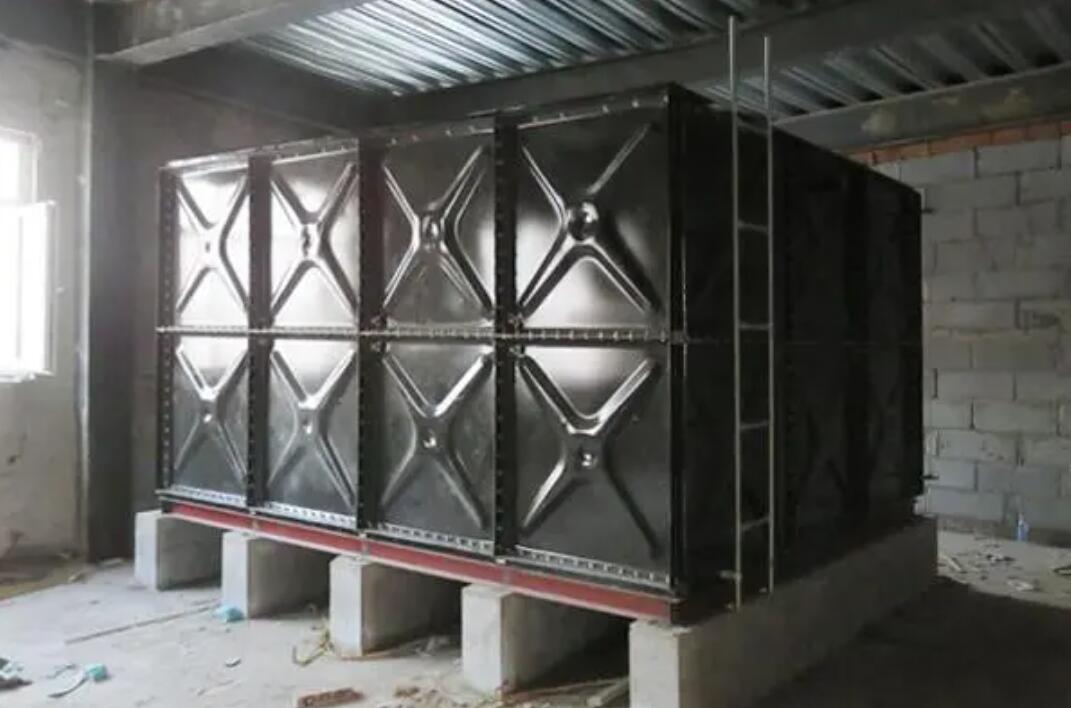
FRP tanks feature modular assembly. On-site, after the prepared concrete foundation has fully cured, workers assemble panels piece-by-piece using food-grade sealing gaskets and stainless-steel bolts (typically 304 or 316). Assembly follows the sequence: base plates → side plates → bracing system → roof plates. The internal vertical and horizontal bracing system is critical for withstanding hydrostatic pressure, requiring mechanical design based on tank height and capacity. Upon completion, a hydrostatic test is mandatory: the tank is filled and held for 24-48 hours, with acceptance criteria being zero leakage and negligible deformation (settlement less than 1/500).
IV. Quality Control and Process Evolution
A robust process necessitates comprehensive quality control. Traceable records must be maintained for raw material intake, in-process parameters (e.g., ambient temperature/humidity, resin mix ratio, lay-up log), and final product performance. The industry is evolving towards greater efficiency and sustainability, adopting techniques like Vacuum Infusion Processing (VIP) for superior fiber wet-out and consistency, developing low-styrene-emission resins, and embedding smart sensors in molds to monitor cure status.
Conclusion
The production of FRP water tanks is a systematic engineering endeavor integrating materials science, structural mechanics, and process chemistry. Their exceptional performance is the direct result of precise control throughout the entire workflow—from mold preparation and lamination to curing management and meticulous assembly. The practice of Beijing Yuanhui FRP Co., Ltd. demonstrates that only by strictly adhering to process parameters and quality standards at every stage can manufacturers produce safe, durable, and reliable FRP water tanks that meet diverse storage needs. A deep understanding and continuous refinement of the production process remain the core drivers of industry advancement.