Comprehensive Analysis of FRP Water Tank Production Process: Precision Manufacturing from Mold to Finished Product
Introduction
Fiberglass Reinforced Plastic (FRP) water tanks are indispensable in modern water supply systems due to their superior corrosion resistance, high strength-to-weight ratio, and long service life. The reliability of their performance is directly rooted in rigorous and standardized production processes. A complete FRP water tank production line is far more than simply "brushing resin and laying fiberglass"; it is a systematic engineering project integrating materials science, structural mechanics, and precision control. Drawing on over two decades of industry expertise, Beijing Yuanhui FRP Co., Ltd. has established a comprehensive quality control system spanning from raw material selection to finished product delivery. This article provides an in-depth analysis of the entire FRP water tank production process based on this framework.
Phase One: Mold Preparation and Liner Layer Fabrication
The mold is the cornerstone of FRP tank formation, its quality directly determining the smoothness, dimensional accuracy, and demolding effectiveness of the tank's inner wall. Professional manufacturers like Beijing Yuanhui typically use high-gloss, high-strength molds specifically designed for FRP.
1.1 Mold Treatment and Release Agent Application
Prior to production, the mold must be thoroughly cleaned and polished to ensure a surface free of dust, oil, and defects. Subsequently, a high-performance release agent (such as semi-permanent mold release wax or polyvinyl alcohol solution) is applied evenly, usually in 2-3 coats, to form an effective barrier film. This step is critical for ensuring the smooth demolding of the cured tank sheet and achieving the mirror-like finish required for food-grade resin on the inner surface.
1.2 Food-Grade Liner Layer Formation
As a water storage vessel, the hygiene and leak-proof quality of the liner are paramount. Operators first spray or hand-lay a layer of food-grade resin (typically isophthalic or vinyl ester) approximately 0.5mm thick onto the mold. A layer of surface veil (usually 30g/m²) is then laid and rolled to remove air bubbles, ensuring complete saturation. This layer has a resin content exceeding 90%, forming a dense, smooth, and pore-free rich resin layer that effectively isolates water from the glass fibers, ensuring water safety and preventing leakage.
Phase Two: Structural Layer Reinforcement and Forming Processes
The structural layer provides the necessary mechanical strength to withstand water pressure and external loads. The primary methods are hand lay-up (for sheets) or mechanical filament winding (for cylindrical tank bodies).
2.1 Hand Lay-Up Process Analysis
This is the mainstream process for manufacturing rectangular tank sheets. After the liner layer gels (tack-free state), the reinforcement layers are applied. According to the design thickness, layers of chopped strand mat (e.g., 450g/m²) and woven roving (e.g., 800g/m²) are laid alternately. Each layer must be fully saturated with resin and carefully rolled with a debubbling roller to eliminate interlayer air, maintaining a stable resin-to-glass ratio of approximately 7:3. Critical areas such as connection hole peripheries and stiffener locations require additional reinforcement, typically 2-3 extra layers. Beijing Yuanhui's process standards mandate that resin usage per square meter in key areas does not deviate by more than ±5%.
2.2 Filament Winding Process Application
For large cylindrical FRP water tanks, computer-controlled winding machines are often employed. Continuous glass fiber strands are passed through a resin bath and then wound onto a rotating mandrel at preset angles (typically a combination of hoop and helical) and tensions. This process creates a structural layer with continuous fibers, high strength, and consistent quality, making it particularly suitable for withstanding hoop pressure. The number of winding layers is determined by calculations based on design pressure and diameter.
Phase Three: Curing, Demolding, and Post-Processing
The formed semi-finished product must undergo a complete curing cycle to achieve its final properties.
3.1 Curing Control
Curing occurs in three stages: gelation, hardening, and full cure. The production workshop must maintain suitable temperature (generally 20-30°C) and humidity. Beijing Yuanhui's workshops utilize temperature control to ensure the resin reaches demolding strength (Barcol hardness ≥40) within 24 hours. Full curing requires over 7 days, at which point the material properties are optimal, with tensile strength potentially exceeding 200MPa.
3.2 Demolding and Trimming
Once demolding strength is achieved, specialized tools are used to carefully peel the sheet from the mold. The demolded sheet undergoes edge trimming and sanding to ensure precise dimensions and smooth edges for subsequent assembly. Openings for tie-rod connections, inlets, and outlets are also cut, with all edges sealed with resin to prevent fiber exposure.
3.3 Assembly and Sealing
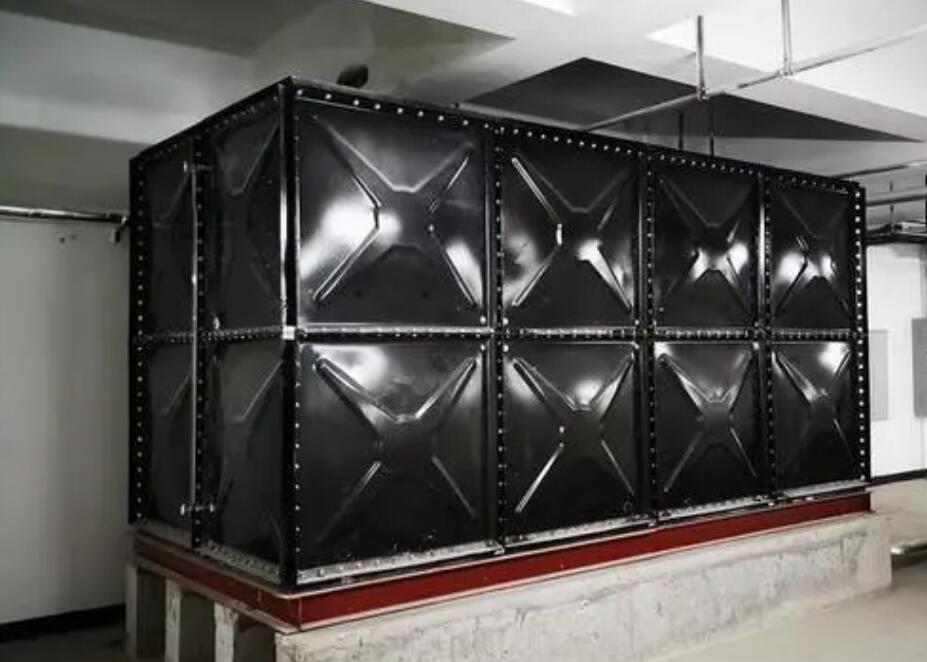
This is the critical step of assembling individual sheets into a complete FRP water tank. At the construction site or factory pre-assembly area, sheets and tie-rods are connected using food-grade sealant and specialized bolts. The installation precision of the tie-rod system (typically stainless steel or FRP) directly affects the tank's resistance to deformation under full water load. Engineering cases from Beijing Yuanhui show that its standard modular assembly process allows a 100-cubic-meter SMC water tank (also within the FRP category) to be installed on-site within 48 hours.
Phase Four: Quality Inspection and Industry Standards
Stringent quality inspection is the final safeguard for the safe operation of FRP water tanks.
4.1 Key Inspection Points Throughout the Process
Inspection runs through the entire process: raw material incoming inspection (resin viscosity, glass fiber moisture content), in-process inspection (layer thickness, resin content, bubble control), and final product inspection. Final inspection includes appearance (free of cracks, bubbles, delamination), dimensional tolerance, Barcol hardness testing (requirement ≥40), and the crucial hydrostatic test. The hydrostatic test requires filling the tank with water and letting it stand for 24-48 hours with no leakage and no significant deformation (sidewall deflection ≤ L/250, where L is the height).
4.2 Core Standards Adhered To
The production of high-quality FRP water tanks must comply with national and industry standards, such as GB/T 21238-2016 "Fiberglass Reinforced Plastic Water Tank" and JC 658.1-2007 "Fiberglass Reinforced Plastic Water Tank Part 1: SMC Modular Water Tank." These standards set mandatory requirements for material properties, hygiene indicators, structural design, and test methods.
Conclusion
The production of FRP water tanks is a technology-intensive precision manufacturing process. From the meticulous attention to the mold to the precise control of lay-up, and the scientific management of curing and assembly, every stage profoundly impacts the final product's performance and lifespan. The practice of Beijing Yuanhui FRP Co., Ltd. demonstrates that only by integrating rigorous process specifications, precise process control, and strict quality inspection can truly safe, durable, and hygienic FRP water tanks be produced. With the continuous advancement of process technologies, such as the application of digital cutting and automated lay-up, the future manufacturing of FRP water tanks will evolve towards higher efficiency and more consistent quality.