Seismic Performance Analysis and Key Design Specifications for FRP Water Tanks
Seismic Performance Analysis and Key Design Specifications for FRP Water Tanks
Earthquake damage to water supply systems directly impacts post-disaster rescue and recovery. As critical water storage facilities, the seismic performance of Fiber Reinforced Plastic (FRP) water tanks is paramount. Their unique material properties and structural configurations offer significant advantages under seismic loads, but they must also adhere to rigorous design and construction codes.
Seismic Advantages and Mechanical Properties of FRP Materials
FRP is a composite material consisting of glass fiber reinforcement embedded in a polymer resin matrix. Its core seismic advantage stems from material anisotropy and high specific strength. Unlike concrete tanks prone to brittle cracking or steel tanks susceptible to buckling, FRP exhibits excellent tensile strength (often exceeding 300 MPa) and considerable elastic deformation capacity. With a typical elastic modulus of 20-30 GPa, FRP tanks can absorb and dissipate seismic energy through elastic deformation rather than rigid resistance.
Engineering practices at Beijing Yuanhui FRP Co., Ltd. demonstrate that optimizing fiber layup orientation (e.g., ±45° plies) and resin formulation (e.g., toughened epoxy) can further enhance tank toughness and shear resistance, enabling adaptation to multi-directional seismic waves. This tailor-ability at the material level is a distinct advantage over traditional tank materials.
Seismic Structural Design and Critical Joint Details
Superior seismic performance relies not only on material but also on scientific structural design, focusing on integrity, uniformity, and connection reliability.
Tank Body Design
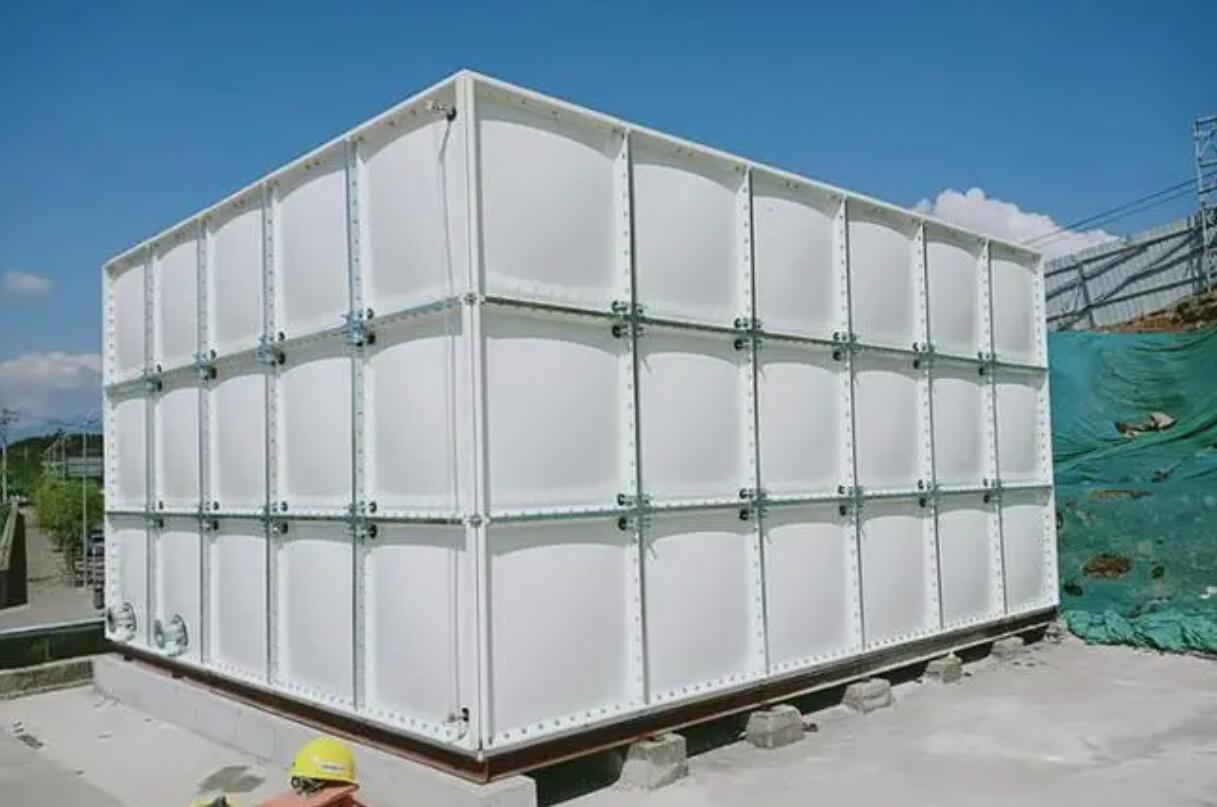
Modern large FRP tanks typically employ modular bolted construction. To ensure integrity, connections between panels must possess sufficient strength and stiffness. Beijing Yuanhui FRP Co., Ltd. utilizes a proprietary sealing connection system that incorporates high-polymer gaskets and continuous lamination of internal FRP stiffeners at joints, achieving seam strength over 85% of the panel strength. This effectively prevents leakage or cracking due to stress concentration during earthquakes.
Foundation and Anchorage System
The tank-to-foundation connection is a critical seismic weak point. Design codes require anchorage systems to resist overturning moments, sliding forces, and uplift forces generated by earthquakes. According to China's Code for Seismic Design of Buildings (GB 50011), for regions with a seismic fortification intensity of 8 degrees, the safety factor for anchor bolt pull-out force should not be less than 2.5. Common practices involve welding or bolting tank bottom steel embedments to pre-embedded foundation bolts, along with uniformly distributed seismic isolation bearings at the tank base to dampen kinetic energy.
Overview of Domestic and International Design Codes
The seismic design of FRP water tanks is guided by a series of established codes and standards.
Chinese Standard System
Design in China primarily follows GB 50011 and the Code for Structural Design of Water Supply and Wastewater Engineering Structures (GB 50069). These stipulate that water storage facilities in key areas must meet the three-level seismic fortification criteria: "no damage under frequent earthquakes, repairable under moderate earthquakes, and no collapse under rare earthquakes." The industry standard FRP Water Tanks (JC/T 658.1) specifies raw materials, structural types, and test methods, ensuring basic product quality. Seismic calculations must consider hydrodynamic pressures (convective and impulsive components) on tank walls, treating the tank and water as a coupled system.
International Reference Standards
Methodologies for seismic load calculation from American standards like AWWA D120 (for bolted steel tanks) and API 650 (for welded steel oil storage tanks) are often referenced for FRP tank analysis, particularly regarding sloshing effects. Given Japan's high seismic risk, its Japan Water Works Association Specifications impose more stringent details for FRP tanks, including stiffener spacing and roof-to-shell connection strength.
Engineering Case Studies and Performance Verification
Theoretical designs and codes must be validated through practice. A 120-cubic-meter rectangular FRP tank produced by Beijing Yuanhui FRP Co., Ltd. and installed in a key hospital during the post-Wenchuan earthquake reconstruction remained fully functional through subsequent aftershocks. This tank was designed for a seismic intensity of 9 degrees, featuring reinforced corners (local thickness up to 25mm) and a unique "#"-shaped bottom support frame.
Laboratory verification is equally vital. Finite Element Analysis (FEA) software enables modal and time-history analysis of tank models under different seismic waves (e.g., El-Centro, Taft), simulating stress-strain distribution. Shake table testing provides direct observation of dynamic response and liquid sloshing, informing the optimization of anti-sloshing devices.
Conclusion
The outstanding seismic performance of FRP water tanks results from the synergy of material science, structural mechanics, and adherence to design codes. Every aspect—from the high-toughness FRP composite material and the integral design of modular structures to rigorous seismic calculation and anchorage per domestic and international standards—is crucial for water storage safety during earthquakes. As seismic theory advances and material technology progresses, FRP tank design will become more refined and intelligent. For owners and designers, partnering with experienced suppliers like Beijing Yuanhui FRP Co., Ltd. and ensuring full compliance from design and installation to inspection is fundamental to guaranteeing the resilience of this critical infrastructure.