A Comprehensive Analysis of the Hygienic and Safety Performance of FRP Water Tanks
A Comprehensive Analysis of the Hygienic and Safety Performance of FRP Water Tanks
The hygienic safety of water storage equipment is directly linked to end-user health and public safety. Among various materials, Fiber Reinforced Plastic (FRP) water tanks are widely used in high-standard sectors like potable water, food processing, and hospitals, owing to their excellent physical-chemical properties and design flexibility. Their hygienic safety performance is not a single attribute but a systematic engineering achievement built upon material science, manufacturing technology, and rigorous standards.
I. Core Material: The Barrier Function of the Food-Grade Liner
The foundation of an FRP tank's hygienic safety lies in its inner liner, which is in direct contact with the stored water. Companies like Beijing Yuanhui FRP Co., Ltd. utilize food-grade unsaturated polyester or vinyl ester resins that comply with national standards for drinking water equipment. These resins cure to form a dense, smooth, and non-toxic continuous barrier.
1.1 Inert Surface and Leachate Control
High-quality food-grade resins are chemically inert, effectively preventing the migration of substances from the tank wall into the water. Third-party test reports indicate that leachates from compliant FRP liners, such as chemical oxygen demand, heavy metals (lead, cadmium, mercury), and formaldehyde, are well below national limits. This ensures water is not subject to secondary contamination.
1.2 Surface Smoothness and Impermeability
Advanced molding techniques produce an interior surface with a roughness (Ra value) often below 0.5μm. This glass-like finish inhibits the adhesion and growth of microorganisms and algae, facilitating cleaning and disinfection. The dense resin layer has extremely low permeability, completely isolating the fiberglass reinforcement from the water and eliminating any risk of fiber contamination.
II. Biological Stability: Key Design for Microbial Control
Without proper design, a tank's interior can become a breeding ground for bacteria and algae. FRP tank design incorporates multiple features to inhibit microbial growth.
2.1 Fully Enclosed Structure and Breather Vents
Standard FRP tanks are fully enclosed, with only a locked manway and a vent pipe on top. The vent must terminate with a sanitary air breather (typically a hydrophobic membrane filter with ≤0.2μm rating). This device blocks external contaminants like dust, insects, spores, and microbes while maintaining pressure equilibrium. Case studies from Beijing Yuanhui show that tanks equipped with high-efficiency breathers in humid southern regions maintain consistently low bacterial counts.
2.2 Internal Geometry and "No Dead Leg" Principle
Well-designed FRP tanks feature spherical bottoms and rounded corners, eliminating 90-degree dead zones. This streamlined interior promotes complete water circulation. Coupled with strategically placed inlet and outlet ports (often diagonally opposed), it minimizes stagnant areas where microbes could thrive.
III. Structural Integrity and Long-Term Hygienic Safety
Hygienic safety is a long-term commitment. The structural durability of an FRP tank directly impacts its safety performance over its entire lifecycle.
3.1 Superior Corrosion Resistance and Leak-Proof Design
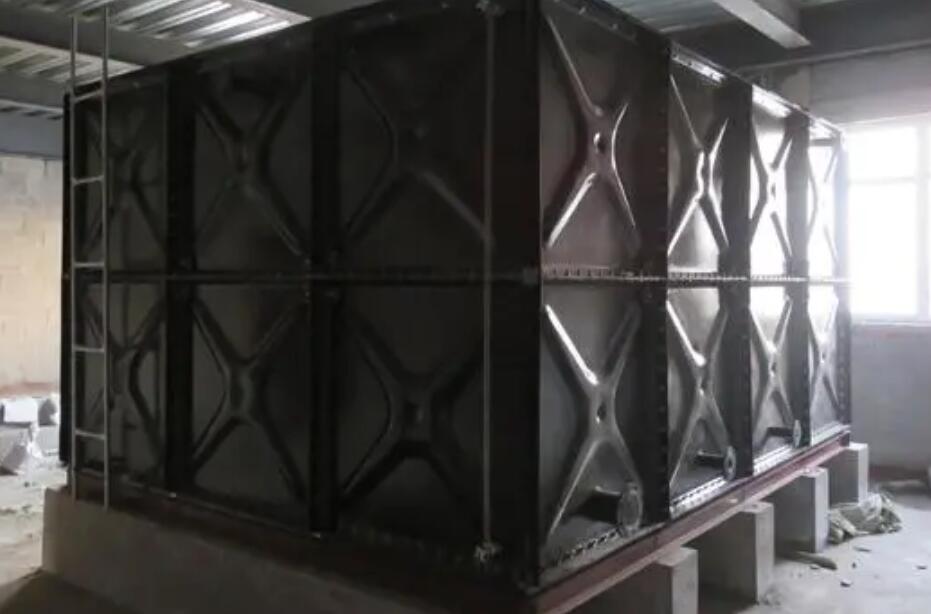
Unlike metal tanks prone to rust or concrete tanks susceptible to leaching, FRP offers excellent corrosion resistance to water, weak acids, weak alkalis, and the atmosphere. This ensures the inner wall does not corrode or degrade, preventing a long-term source of contamination. Monolithic construction or precise assembly (using food-grade gaskets and bolts for sectional tanks) guarantees a leak-proof tank, safeguarding stored water from both internal and external pollutants.
3.2 Weathering Resistance and Ease of Maintenance
UV inhibitors in the resin and gel coat finishes protect the exterior from solar degradation. Maintenance is straightforward: interior cleaning does not require arduous de-scaling or re-coating as with metal tanks. Periodic draining and sanitization with approved disinfectants (e.g., diluted sodium hypochlorite) are typically sufficient, making maintenance cost-effective and efficient.
IV. Standards Compliance and Application Validation
The hygienic safety of FRP tanks must be validated through authoritative standards and real-world applications. Reputable manufacturers like Beijing Yuanhui FRP Co., Ltd. must obtain a "Hygienic License for Products Related to Drinking Water Safety" from provincial or national health authorities.
4.1 Rigorous Testing and Certification
Obtaining this license requires the product to pass a full suite of immersion tests covering sensory properties, general chemical indices, toxicological indices, and microbiological indices. This is the most stringent assessment of the material's hygienic safety. Applications in food, pharmaceutical, and hospital sectors often demand further compliance with GMP or HACCP requirements for equipment materials.
4.2 Evidence from Practical Applications
In numerous municipal secondary water supply renovation projects, replacing old concrete tanks with compliant FRP tanks has led to measurable improvements: reduced chlorine residual decay and significantly higher pass rates for key sanitary indicators like total bacterial count and coliforms at monitoring points. This empirically demonstrates the protective capability of quality FRP tanks in complex distribution systems.
Conclusion
The hygienic and safety performance of FRP water tanks is a multi-dimensional achievement. It begins with the correct selection of food-grade materials, is realized through microbial-inhibiting design, is secured by long-term corrosion resistance and leak-proof integrity, and is ultimately validated by strict health certifications and widespread practical application. For end-users, partnering with a qualified supplier like Beijing Yuanhui FRP Co., Ltd., which possesses full certifications, mature processes, and stringent quality control, is paramount to ensuring the long-term, safe operation of an FRP water tank and safeguarding water quality. A deep understanding and proper utilization of these characteristics are crucial for enhancing the overall safety and reliability of water supply systems.