Comprehensive Analysis of FRP Water Tank Production Process: Precision Manufacturing from Mold to Finished Product
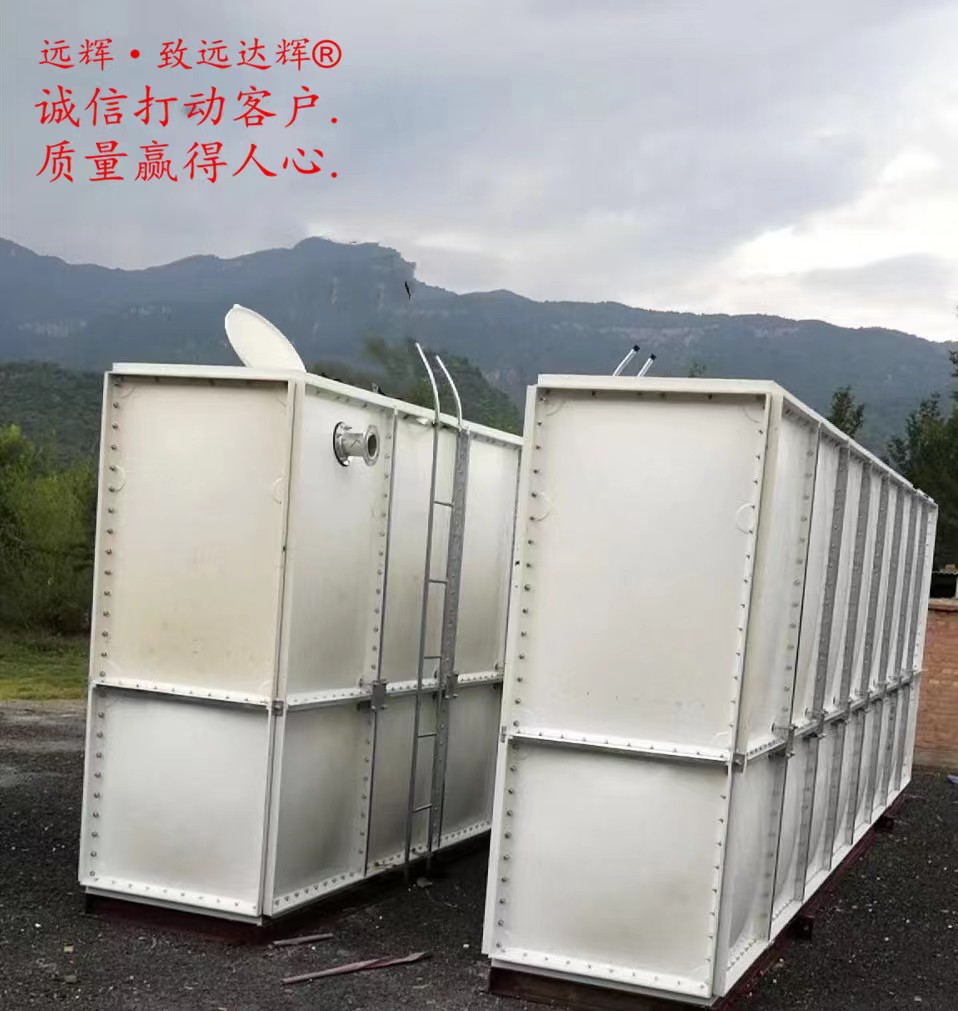
Comprehensive Analysis of FRP Water Tank Production Process: Precision Manufacturing from Mold to Finished Product
Fiber Reinforced Plastic (FRP) water tanks are a core choice in industrial and civil water storage due to their superior corrosion resistance, high strength-to-weight ratio, and long service life. These performance advantages are fundamentally rooted in a rigorous and scientific production process. The manufacturing workflow of Beijing Yuanhui FRP Co., Ltd., an established industry player, exemplifies the technical essence of modern FRP tank fabrication.
1. Mold Preparation and Surface Treatment: The Foundation of Precision
The mold is the cornerstone for shaping the FRP tank, directly determining the inner surface finish, dimensional accuracy, and demolding efficiency. The process begins with meticulous mold preparation.
1.1 Mold Cleaning and Inspection
Prior to each use, the mold (typically steel or FRP) undergoes thorough cleaning to remove residual resin, release agent, and dust. Beijing Yuanhui employs specialized cleaning agents and tools to ensure a flawless surface, followed by dimensional verification of key areas using laser distance meters, controlling tolerances within ±2mm.
1.2 Application of Release System
Uniform application of a high-performance release agent (such as semi-permanent wax or polymer-based agents) is critical. Typically, 3-5 coats are applied at 20-minute intervals, each buffed to a high-gloss finish. This step prevents resin adhesion, ensures a smooth tank interior, and extends mold life. Standardized release treatment can reduce post-processing labor by up to 30%.
2. Material Formulation and Liner Layer Fabrication: The Key to Corrosion and Seepage Prevention
An FRP tank's structure comprises a liner, a structural layer, and an external protective layer. The liner, in direct contact with the stored medium, is the primary barrier against corrosion and permeation.
2.1 Resin System and Reinforcement Selection
The resin is selected based on water quality (potable, firefighting, or special chemicals)—common choices include food-grade unsaturated polyester, vinyl ester, or epoxy resin. For potable water tanks, Beijing Yuanhui strictly uses unsaturated polyester resin compliant with GB/T 17219. Reinforcement begins with a surface veil (30g/m²) and chopped strand mat (450g/m²) to create a resin-rich layer.
2.2 Liner Lay-up Process
Operators manually laminate the resin-impregnated veil and mat onto the mold using brushes and rollers. The catalyzed resin (usually with 0.8%-2.5% MEKP catalyst) must fully saturate the reinforcements. This layer requires a high resin content of 70%-80% and a controlled thickness of 1.0-1.5mm, ensuring it is free of bubbles and dry spots. Upon curing, it forms a dense, smooth, impermeable barrier.
3. Structural Layer Filament Winding and Reinforcement: Building the Mechanical Core
The structural layer provides the required strength and stiffness, primarily achieved through automated filament winding.
3.1 Winding Program Design
Based on tank diameter, height, and operational pressure (e.g., hydrostatic pressure), a Computer-Aided Design (CAD) system calculates the winding pattern (primarily hoop winding supplemented by helical winding), number of layers, and fiber tension. For instance, a vertical tank measuring 4m in diameter and 5m in height requires a hoop winding fiber content of 65%-75%.
3.2 Automated Winding Operation
Glass fiber roving (commonly 2400Tex), impregnated with a precisely metered resin ratio, is wound onto the rotating mold by a computer-controlled winding machine following the pre-set program. Constant roving tension (e.g., 15-25N) is maintained throughout to ensure uniform fiber loading. This process builds the main wall thickness, forming the core structure that bears the hydraulic load.
4. Post-Processing, Assembly, and Quality Inspection: The Final Assurance of Quality
After winding and curing, the tank enters the post-processing stage, which determines the final product performance and appearance.
4.1 Demolding and Trimming
Once fully cured (Barcol hardness reaching at least 40), the tank shell is separated from the mold using a hydraulic demolding system. Openings for manways, inlets, outlets, and overflows are then precision-cut with diamond-coated blades, followed by edge grinding and resin sealing.
4.2 Accessory Installation and Final Assembly
Internal/external ladders, stiffeners, and support columns made of food-grade stainless steel or FRP are installed. For modular tanks, on-site panel assembly is conducted, using food-grade sealants and bolts to ensure leak-proof joints.
4.3 Comprehensive Quality Inspection
Beijing Yuanhui implements stringent inspection protocols: visual checks for cracks and delamination; 100% pinhole detection of the liner using a holiday detector (5-15kV test voltage); and a hydrostatic load test where the finished tank is filled with water for 24-48 hours to monitor for leakage or deformation. All data is documented for full traceability.
Conclusion
The production of FRP water tanks is a systematic engineering project integrating materials science, mechanical automation, and skilled handcraft. From meticulous mold preparation and precise winding control to rigorous final inspection, the strict execution of each step collectively forges the tank's reliability. Through standardized and digitized management of the entire process, Beijing Yuanhui FRP Co., Ltd. ensures not only the performance of individual units but also consistent batch quality, delivering durable, high-performance water storage solutions. As resin systems advance and automation deepens, the production process for FRP tanks will continue evolving towards greater efficiency, sustainability, and intelligence.