An In-Depth Analysis of the Hygienic and Safety Performance of FRP Water Tanks: From Material Science to Engineering Practice
An In-Depth Analysis of the Hygienic and Safety Performance of FRP Water Tanks: From Material Science to Engineering Practice
The hygienic and safety performance of Fiber Reinforced Plastic (FRP) water tanks, as the core storage equipment in secondary water supply systems, is directly linked to the safety and health of end-users' drinking water. This performance is not a single metric but a systematic engineering achievement built upon material science foundations, manufacturing processes, structural design, and long-term service behavior. Drawing from over two decades of industry practice at Beijing Yuanhui FRP Co., Ltd., a thorough interpretation of FRP tank hygiene must delve into the molecular level and full lifecycle management.
I. The Foundation of Safety: Food-Grade Resin and Alkali-Free Fiberglass
The inherent hygiene of an FRP tank is primarily determined by the quality of its raw materials. The food-grade unsaturated polyester resin used for the inner liner layer is critical. This resin must comply with stringent national standards, such as China's GB/T 17219-1998, which evaluates the safety of equipment and materials in contact with drinking water. The residual styrene monomer content after curing should be below 0.1%. A high-quality food-grade resin forms a dense, smooth, and chemically inert gel coat, effectively isolating the fiberglass from water, preventing fiber leaching, and inhibiting microbial adhesion on the tank wall.
The choice of reinforcement material is equally vital. Reputable manufacturers like Beijing Yuanhui FRP Co., Ltd. insist on using alkali-free fiberglass (E-glass) and its fabrics. Compared to medium-alkali fibers, E-glass offers superior water resistance and chemical stability, with minimal ion leaching (e.g., sodium, potassium ions), thereby avoiding any potential impact on water taste or safety. The optimal bonding between resin and fiberglass constitutes the first and most crucial barrier for water safety.
II. Process and Structure: Eliminating Sanitary Dead Ends and Contaminant Ingress
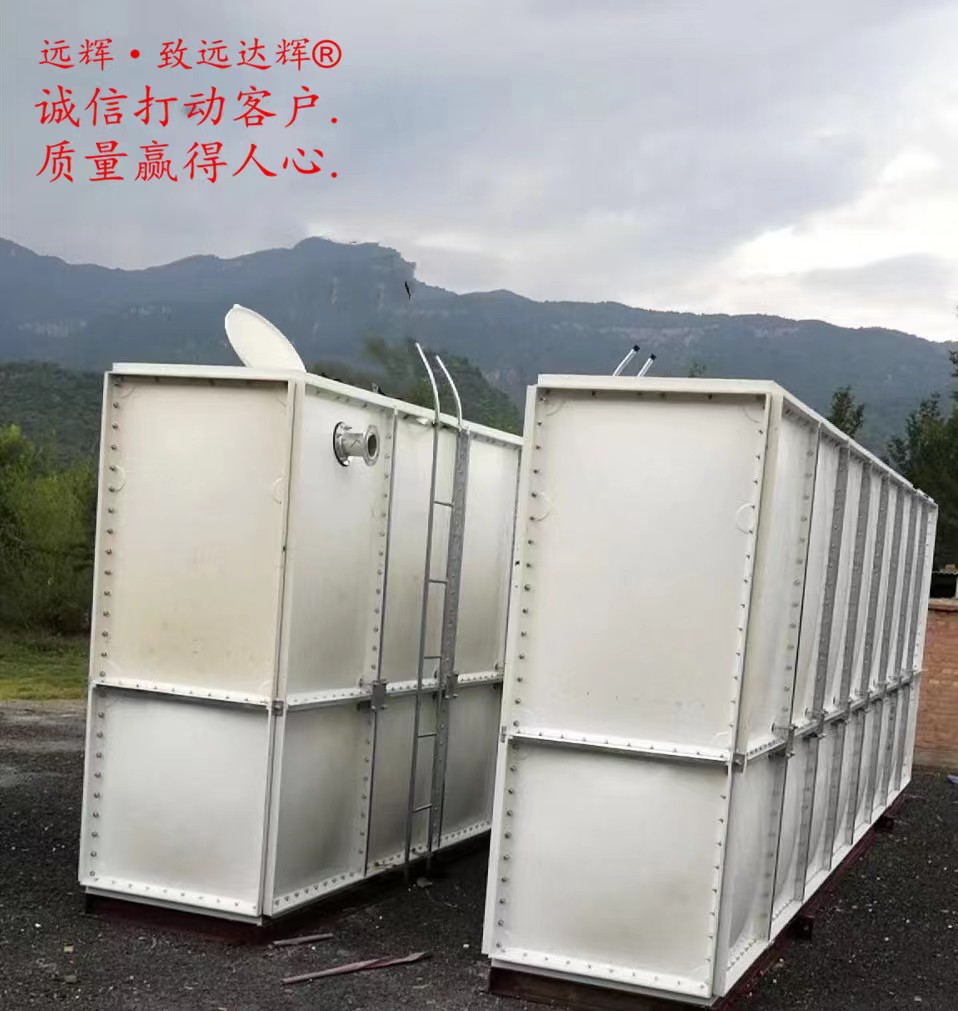
Superior materials must be transformed into safe products through precision engineering. The molding process is key to ensuring a seamless structure for FRP water tanks. While traditional拼接 tanks have sealant joints prone to bacterial growth, computer-controlled compression molding produces panels with平整 edges and precise sealing grooves. When assembled using food-grade sealing gaskets and bolts, they achieve a permanent seal, fundamentally eliminating the risk of leakage and contamination from gaps.
Internal structural design directly impacts hygiene. All internal bracing should be positioned externally, ensuring the inner wall is smooth, free of protrusions and dead corners, facilitating cleaning. Accessories like manholes, ladders, overflow pipes, and drain outlets should be made of 304 or 316 stainless steel. Their connection points to the FRP panels require specialized waterproof sealing to prevent corrosion or leakage. Vent pipes must be equipped with insect and dust screens (at least 40 mesh) to allow air circulation while blocking external contaminants.
III. Microbial Control and Water Quality Preservation
For long-term water storage, controlling microbial growth is a central hygiene challenge. The FRP material itself provides no nutrients, and its smooth interior surface hinders the attachment and proliferation of bacteria and algae. According to tests by relevant Chinese environmental health institutes, under identical conditions, the bacterial adhesion rate on the inner wall of a high-quality FRP tank can be over 70% lower than that of a traditional concrete tank.
Furthermore, leading manufacturers like Beijing Yuanhui incorporate antimicrobial agents (e.g., silver-ion or zinc-ion based compounds) into the resin matrix, endowing the inner liner with active bacteriostatic properties. Independent third-party tests show that such modified liners can achieve over 99% inhibition rates against E. coli and Staphylococcus aureus within 24 hours. Additionally, the excellent thermal insulation properties of FRP help moderate water temperature fluctuations within ranges conducive to microbial growth, indirectly aiding water quality preservation.
IV. Long-Term Stability and Leachate Control
Hygienic safety must withstand the test of time. The long-term safety of FRP tanks is reflected in their stability against aging and leaching. Under prolonged exposure to UV radiation, water temperature changes, and trace chemicals in water, inferior tanks may suffer resin degradation, leading to fiber exposure, fragment shedding, or the leaching of harmful small molecules.
Professional manufacturers enhance durability by using high-performance resins (e.g., isophthalic or vinyl ester), adding UV absorbers, and ensuring sufficient curing degree and Barcol hardness (typically ≥40). Accelerated aging and long-term immersion tests conducted by Beijing Yuanhui FRP Co., Ltd. indicate that after continuous immersion in 50°C water for 90 days, the leaching of常规 water quality indicators and heavy metals from their products is significantly below national standard limits, demonstrating high material stability. Regular professional cleaning and maintenance remain essential management practices to ensure hygiene throughout the tank's entire service life.
Conclusion
In conclusion, the hygienic and safety performance of FRP water tanks is a multi-dimensional synthesis. It originates from compliant, food-grade raw materials, is realized through precision manufacturing that eliminates dead ends, is strengthened by proactive microbial control design, and ultimately relies on material stability during long-term service. For facilities with stringent water quality requirements—such as hospitals, schools, food processing plants, and high-end residences—choosing a supplier like Beijing Yuanhui FRP Co., Ltd., which emphasizes material integrity and工艺细节, means opting for water safety assurance from source to tap. The future of the industry will undoubtedly focus more on innovations in material science and the enhancement of full lifecycle hygiene management standards, ensuring FRP water tanks continue to be reliable guardians of safe drinking water.