Comprehensive Analysis of FRP Water Tank Production Process: Precision Manufacturing from Raw Materials to Finished Product
Introduction
Fiber Reinforced Plastic (FRP) water tanks have become a core component in modern water supply, firefighting, and industrial water storage systems due to their excellent corrosion resistance, high strength-to-weight ratio, and long service life. The reliability of their performance is directly dependent on the rigor and scientific precision of the production process. A complete FRP tank manufacturing process is far more than simply "brushing resin and laying fiberglass"; it is a systematic engineering project integrating materials science, structural mechanics, and precision manufacturing. This article provides an in-depth analysis of this entire workflow, using the practices of industry benchmark company Beijing Yuanhui FRP Co., Ltd. as a case study to reveal the manufacturing logic behind high-quality water tanks.
Core Molding Processes: The Technical Choice Between Hand Lay-up and Filament Winding
The forming of FRP water tanks primarily relies on two core processes: Hand Lay-up and Mechanical Filament Winding. The choice between them directly impacts the mechanical properties and production efficiency of the tank.
Hand Lay-up Process: The Art of Customization
The hand lay-up process is suitable for producing tank panels with complex shapes, multiple openings, or non-standard customizations. At Beijing Yuanhui's workshop, this process begins with the preparation of a clean female mold. Technicians first apply a uniform coat of release agent (typically polyvinyl alcohol or wax). Next, a gel coat layer, approximately 0.4-0.6mm thick, is sprayed or brushed on. This layer serves as the first barrier against corrosion for the tank's interior and determines the final surface finish. After the gel coat gels, technicians begin layering the glass fiber reinforcement. Typically, the inner liner layer uses surface mat (30g/m²) and chopped strand mat (450g/m²) to create a resin-rich impermeable layer. The structural layer then employs alternating layers of chopped strand mat and woven roving (e.g., 800g/m²) until the design thickness is achieved. Each layer must be meticulously rolled with a specialized roller to eliminate air bubbles and ensure complete resin impregnation. The resin-to-glass weight ratio (resin content) is strictly controlled between 65%-70%, a critical data point for ensuring panel strength and toughness.
Filament Winding Process: Ensuring Efficiency and Homogeneity
For high-volume, standardized cylindrical tank shells, the filament winding process offers greater advantages. This process uses a computer-controlled winding machine to precisely wind continuous glass fiber strands impregnated with resin onto a mandrel at a preset winding angle (often the "golden angle" of 54.7°) and tension. The six-axis winding machine employed by Beijing Yuanhui enables a composite pattern of hoop winding (providing radial strength) and cross-helical winding (providing axial strength), allowing the tank shell to achieve a hoop tensile strength exceeding 250 MPa. This process allows for more precise resin content control and regular fiber placement, resulting in product consistency and mechanical properties significantly superior to purely hand-laid products.
From Curing to Assembly: Refining the Post-Processing Workflow
The molded semi-finished products must undergo a rigorous post-processing workflow to become qualified tank components.
Curing and Demolding: Mastering Time and Temperature
Curing is the critical stage where the resin undergoes a cross-linking chemical reaction. Beijing Yuanhui employs a staged curing system: initial gelation and preliminary curing at room temperature (not below 15°C) for 8-12 hours, followed by a post-curing stage in a baking room at 40-60°C for 24-48 hours to achieve a resin cure degree above 85%. Thorough post-curing significantly enhances the tank's chemical corrosion resistance and dimensional stability. After demolding, panels are trimmed to remove burrs and flash, with 100% dimensional inspection typically held to a tolerance of ±2mm.
Assembly and Sealing: The Final Hurdle for Structural Integrity
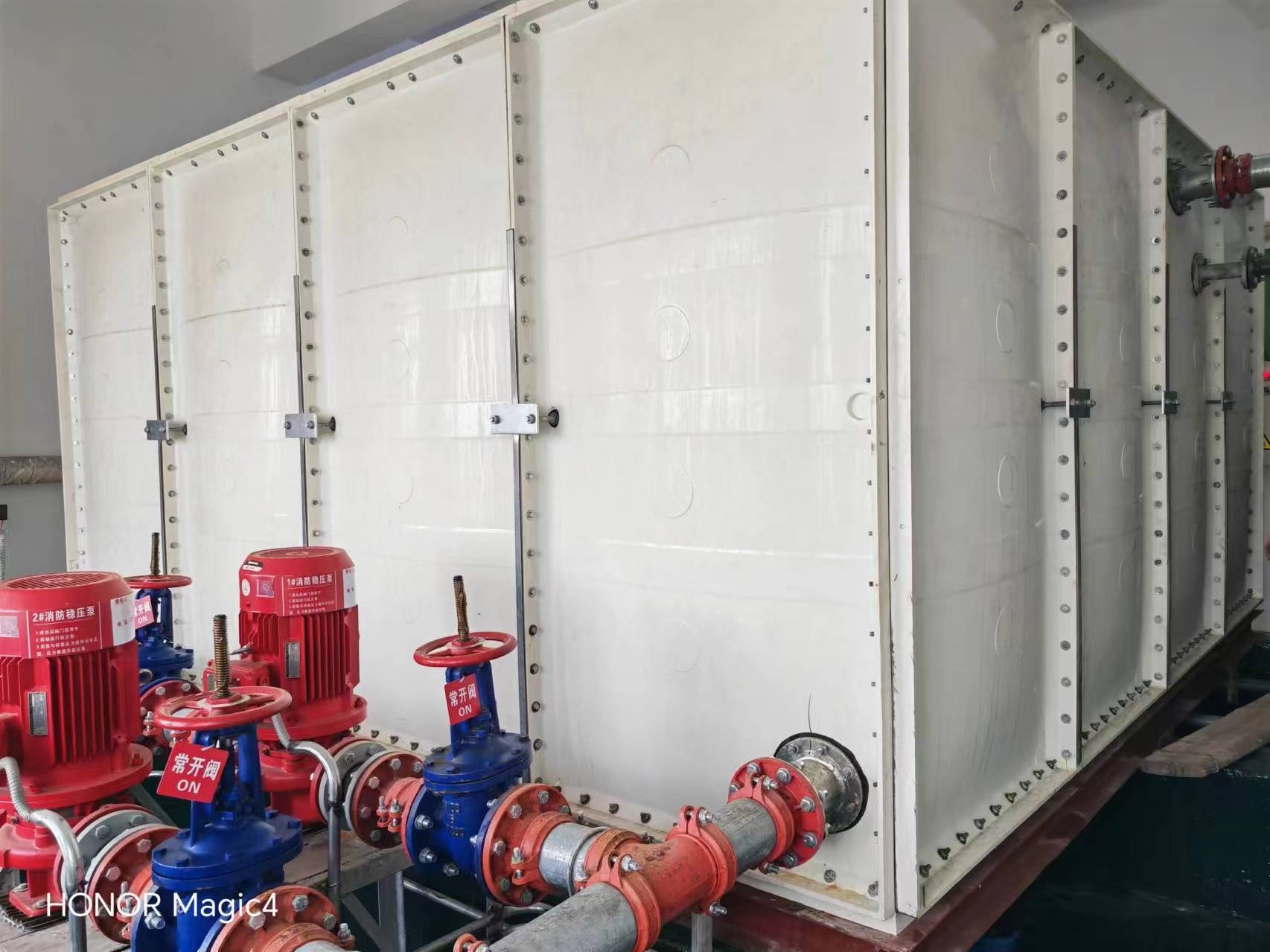
Field assembly of an FRP water tank is akin to assembling a giant 3D puzzle. First, a corrosion-treated channel steel base is installed on the concrete foundation. Individual panels (common sizes: 1m*1m, 1m*0.5m) are then connected in sequence using food-grade stainless steel bolts (e.g., 304 or 316). Torque wrenches must be used during bolt tightening to ensure even force distribution. All panel joints require a three-stage seal: the first is a sealing gasket between panels; the second involves applying solvent-free, non-toxic epoxy resin or specialized FRP mastic to the interior seams; the third repeats the process on the exterior. Beijing Yuanhui's specifications require the sealing material to be full, continuous, and form a smooth transition with an R-angle to eliminate stress concentration and potential leakage.
Quality Control and Performance Testing: Ensuring Fail-Safe Operation
Excellent processes must be paired with a stringent quality control system. The entire production chain is subject to comprehensive inspection from raw material intake to finished product shipment.
Raw Material and In-Process Inspection
Every batch of incoming raw materials—including isophthalic/vinyl ester resin, alkali-free glass fiber, and auxiliaries—requires verification of quality certificates and sampling for retesting of indicators like viscosity, solid content, and fiber tensile strength. During production, dedicated QC personnel conduct巡回抽检 (patrol sampling) on gel coat thickness, layup structure, and resin mix ratio. Laminate samples from the same batch are made for testing Barcol hardness (requirement ≥40) and resin cure degree.
Finished Product Testing and Case Study
Upon completion of assembly, the tank must undergo a water-fill test. According to the Chinese National Standard GB/T 21238-2016, the tank is filled with water and left standing for 24-48 hours to check all seams, joints, and connection points for leakage or significant deformation. Taking Beijing Yuanhui's 800-cubic-meter fire water tank project for an industrial park as an example, its settlement data during the water test was below 2mm, far exceeding standard requirements. The project also passed third-party testing for sanitary performance (immersion water complying with GB 5749) and fire resistance limit. Such rigorous testing is an indispensable final step before delivery to the client.
Conclusion
The production of FRP water tanks is a tightly interlinked technological chain. Every step—from mold preparation, material selection, and molding process to curing, assembly, and final testing—directly impacts the product's ultimate lifespan and safety. Hand lay-up and filament winding processes each have their applicable scenarios, and successful manufacturing lies in the scientific selection and precise control based on product requirements. Leading companies like Beijing Yuanhui FRP Co., Ltd. ensure the exceptional quality of every tank leaving their factory by integrating standardized operations and lean management throughout the entire process. For end-users, understanding this complete production workflow is also crucial for discerning product quality and making informed procurement decisions. In the future, with the further integration of automation and digital technologies, the manufacturing of FRP water tanks will undoubtedly continue to evolve towards greater efficiency, precision, and environmental sustainability.