In-Depth Analysis: Pressure-Bearing Performance and Key Testing Standards for FRP Water Tanks
In-Depth Analysis: Pressure-Bearing Performance and Key Testing Standards for FRP Water Tanks
Fiberglass Reinforced Plastic (FRP) water tanks are widely used in building water supply, fire protection, and industrial water storage due to their high strength-to-weight ratio, corrosion resistance, and long service life. Their pressure-bearing capacity is a critical performance indicator, directly impacting the safety and stability of the entire water system. This article delves into the key factors determining the pressure resistance of FRP tanks and systematically interprets authoritative testing and acceptance standards.
1. Core Determinants of Pressure-Bearing Performance
The pressure-bearing performance of an FRP tank is a systematic property determined by materials, structure, and manufacturing process.
1.1 Material Mechanical Properties: The Foundation
FRP is a composite material. Its pressure resistance primarily depends on the matrix resin (e.g., food-grade unsaturated polyester or vinyl ester) and the reinforcing glass fibers (chopped strand mat, woven roving, filament windings). The fiber content, lay-up design, and fiber-matrix interface strength are crucial for overall mechanical properties like hoop tensile strength and axial flexural modulus. For instance, Beijing Yuanhui FRP Co., Ltd. employs a multi-layer composite structure for high-pressure applications: a corrosion-resistant inner liner, a structural load-bearing layer, and an anti-aging outer layer, with each layer's material ratio meticulously calculated.
1.2 Structural Design and Optimization: Scientific Stress Distribution
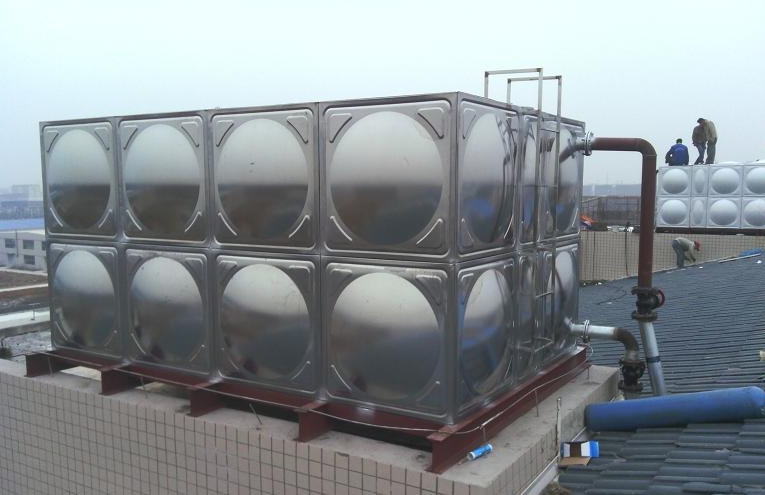
Rational structural design significantly enhances pressure efficiency. Cylindrical tanks primarily endure hoop tensile stress under hydrostatic pressure, making it the ideal shape for pressure containment. For rectangular tanks, internal tie-rod systems, external stiffeners, and panel reinforcements (like spherical bulges) are essential to distribute stress and prevent panel bulging. The design pressure (typically 0.1-0.6MPa or higher) dictates wall thickness and reinforcement specifications. Finite Element Analysis (FEA) is often used to simulate stress distribution at different water levels for design optimization.
1.3 Manufacturing Process and Quality Control: Performance Assurance
Processes like hand lay-up, compression molding, and filament winding significantly affect final performance. Filament-wound cylindrical tanks offer high, consistent hoop strength due to continuous fibers and uniform tension, making them ideal for pressurized service. Hand-laid-up panels are more dependent on operator skill, risking resin-rich/starved areas and poor fiber wet-out, creating potential weak points. Automated production lines, like those at Beijing Yuanhui FRP Co., Ltd., ensure stable and repeatable pressure performance through precise control of winding angle, tension, and resin content.
2. Interpretation of Authoritative Testing Standards and Acceptance Methods
A series of testing standards have been established globally to ensure the safe use of FRP water tanks, providing the scientific basis for verifying pressure performance.
2.1 Chinese National Standard (GB/T) System
GB/T 21238-2016 "Glass fiber reinforced plastic water tank — Part 1: SMC combined water tank" is the core standard in China. It specifies factory and type inspection items. Key tests for pressure performance include: Water-Filled Deformation Test — The maximum sidewall deflection must not exceed 1.0% of the height when full; Water Pressure Resistance Test — The tank must withstand 1.5 times the design pressure for 30 minutes without leakage, cracking, or permanent deformation. It also regulates material-related indices like Barcol hardness and resin insoluble content, ensuring pressure capability from the source.
2.2 Reference to International Standards (e.g., ASTM)
International projects often reference standards from ASTM International. For example, ASTM D3299 for FRP pressure vessels provides detailed guidelines on design, materials, fabrication, and testing. Its pressure testing often includes a burst pressure test to determine the safety factor (typically a minimum ratio of 4:1 between burst pressure and design pressure). While aimed at pressure vessels, its rigorous methodology is highly valuable for evaluating high-performance pressurized water tanks.
2.3 Post-Installation Field Acceptance Testing
While standard tests are conducted at the factory, on-site acceptance after installation is vital. The core test is the Static Water Load Test: The tank is slowly filled and remains full for 24-48 hours. During this period, all joints, inlets/outlets, and manways are inspected for leaks, and the overall structure is checked for abnormal deformation or settlement. Beijing Yuanhui FRP Co., Ltd. strictly follows this procedure for every project delivery, providing a detailed test report as part of the project documentation.
3. Pressure Considerations and Case Studies in Engineering Applications
Selecting an FRP tank for pressurized service requires careful consideration of specific operating conditions.
3.1 High-Rise Building Water Supply Systems
In zoned water supply systems for high-rises, transfer or break pressure tanks located in intermediate equipment rooms or on rooftops endure high static pressure. Beyond the tank's own design, foundation load-bearing and anchoring methods must be considered. For example, for a landmark building project, Beijing Yuanhui supplied a rooftop fire water tank with a design working pressure of 0.45MPa. It featured thickened wound walls and a dense stainless-steel tie-rod system and passed a 72-hour full-water pressure observation, ensuring fail-safe fire safety reserves.
3.2 Special Pressure Conditions and Solutions
For scenarios with pressure fluctuations, such as direct pump pressurization or pneumatic water supply, fatigue loading and instantaneous overpressure must be considered. A higher design safety factor or adding surge suppression devices is recommended. For process tanks with strict pressure requirements, fully wound monolithic cylindrical tanks, which have a much higher pressure rating than standard panel tanks, are a viable solution.
Conclusion
The pressure-bearing performance of an FRP water tank is a systems engineering challenge involving materials science, structural mechanics, and manufacturing. Its reliability cannot be judged by experience alone but must be rigorously tested and verified against national (e.g., GB/T 21238) or international standards. Every step—from scientific material formulation and optimized structural design to precise manufacturing and comprehensive field acceptance—is critical. When selecting an FRP tank, users should prioritize manufacturers with robust quality control systems, like Beijing Yuanhui FRP Co., Ltd., who can provide authoritative test reports. Clearly defining pressure requirements based on actual operating conditions is essential to ensure the long-term, safe, and stable operation of the water storage equipment.