A Comprehensive Analysis of the FRP Water Tank Production Process: From Mold to Finished Product
A Comprehensive Analysis of the FRP Water Tank Production Process
Fiber Reinforced Plastic (FRP) water tanks are pivotal in modern water supply, firefighting, and industrial storage due to their superior corrosion resistance, high strength-to-weight ratio, and long service life. The reliability of these tanks is fundamentally rooted in a meticulous and standardized production process. The manufacturing workflow at Beijing Yuanhui FRP Co., Ltd. exemplifies this precise transformation from raw materials to high-performance products.
I. Production Preparation and Mold Treatment
Quality begins with the mold. Prior to production,专用 molds are designed and fabricated according to tank specifications (common capacities range from 10 to 500 tons). The mold surface must achieve a mirror finish, which directly dictates the smoothness of the tank's interior and the success of demolding. At Beijing Yuanhui FRP, molds undergo a minimum of three stages of grinding and polishing before application of a high-quality release agent (e.g., PVA or wax-based), ensuring flawless demolding.
1.1 Raw Material Inspection and Cutting
Core materials include alkali-free glass fiber rovings, chopped strand mat (CSM), surface veil, and unsaturated polyester resin (e.g., isophthalic or food-grade). Resin viscosity is controlled between 300-500 mPa·s, with gel time adjusted for ambient temperature. Glass fiber fabrics are precision-cut via CNC to within ±2mm tolerance, ensuring layup accuracy and material efficiency.
II. Core Forming Processes: Hand Lay-up and Filament Winding
FRP tank formation primarily relies on two techniques: hand lay-up (for modular panel tanks) and filament winding (for monolithic cylindrical tanks).
2.1 Hand Lay-up Process
This is the standard method for producing flat and curved tank panels. Operators sequentially lay surface veil, CSM, and woven roving onto the mold, saturating each layer with resin using rollers to eliminate air bubbles. A typical 1m*1m panel from Beijing Yuanhui features a laminate sequence: 1 layer of 30g surface veil + 2 layers of 450g CSM + 1 layer of 800g woven roving, resulting in a ~4mm thickness. Resin content is strictly maintained at 50%-55% for optimal mechanical and corrosion-resistant properties.
2.2 Filament Winding Process
For large monolithic tank cylinders, computer-controlled winding machines are employed. Resin-impregnated glass fiber rovings are continuously wound onto a rotating mandrel at predetermined angles (primarily hoop winding with some helical patterns). Precise control over fiber tension, winding speed, and resin content yields a cylinder with exceptional hoop strength. A 3m diameter by 4m high cylinder typically requires 6-8 hours of winding.
III. Curing, Post-Processing, and Quality Control
3.1 Curing and Demolding
Formed parts cure under controlled temperature (ideally 20-25°C). Demolding occurs after initial gelation, but full cure (achieving a Barcol hardness above 40) usually takes 24-48 hours. Beijing Yuanhui utilizes temperature-stable curing zones to ensure consistent product performance.
3.2 Machining and Assembly Preparation
Fully cured panels or cylinders undergo cutting and drilling (for manholes, nozzles). Diamond-tipped tools with water jets or mechanical cutters ensure clean edges. All connecting flanges are ground flat to guarantee sealing integrity during assembly.
3.3 Rigorous Quality Inspection Protocol
Every panel is subjected to multiple checks: visual inspection (for bubbles, cracks, delamination); thickness measurement (±0.2mm tolerance); Barcol hardness test (≥40); and the critical water-fill test. Beijing Yuanhui also samples each batch for laboratory testing of flexural strength (≥150MPa) and resin content, with all data archived for traceability.
IV. On-site Assembly and Final Acceptance
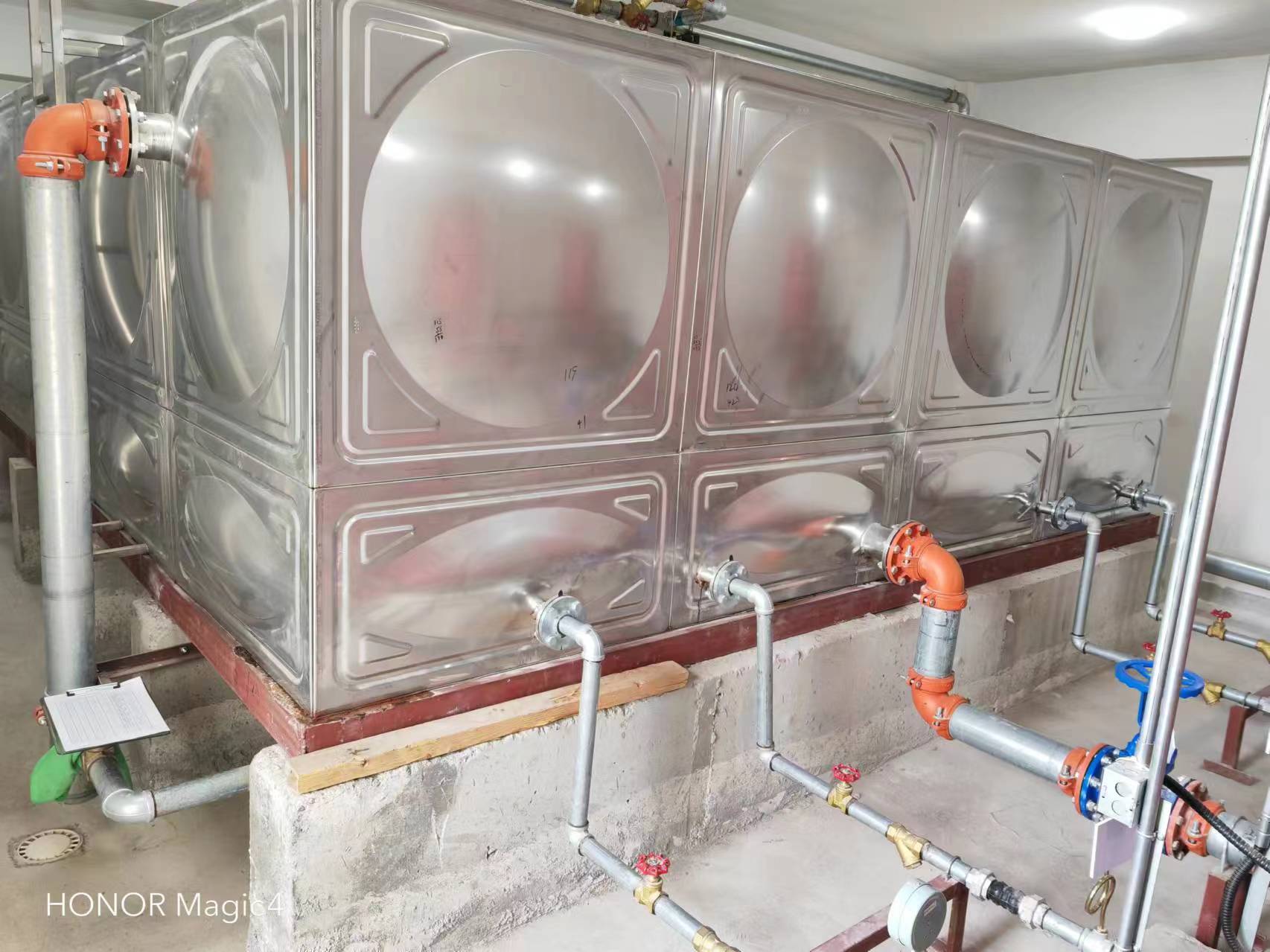
On-site assembly of modular tanks is an extension of the production process. After foundation inspection, certified technicians assemble numbered panels using food-grade sealant and bolts. Upon completion, a mandatory 24-hour hydrostatic test is conducted to verify zero leakage at seams and no visible deformation before final acceptance and commissioning.
Conclusion
The production of FRP water tanks is a systematic engineering endeavor integrating materials science, process control, and rigorous management. Every step, from mold preparation to resin curing and from laminate design to hydrostatic testing, directly impacts the tank's long-term performance. Professional manufacturers like Beijing Yuanhui FRP Co., Ltd., through standardized, data-driven process control, ensure each FRP tank meets its designed service life (often exceeding 20 years), delivering safe and reliable water storage solutions. A deep understanding of this production process holds significant value for client selection and overall industry quality advancement.