A Comprehensive Analysis of the FRP Water Tank Production Process: Precision Manufacturing from Mold to Finished Product
A Comprehensive Analysis of the FRP Water Tank Production Process: Precision Manufacturing from Mold to Finished Product
Fiberglass Reinforced Plastic (FRP) water tanks are essential in modern water supply systems due to their superior corrosion resistance, high strength-to-weight ratio, and long service life. The performance of these tanks is directly determined by the rigor and technical proficiency of their production process. A complete FRP tank manufacturing cycle is far more complex than simply "brushing resin and laying fiberglass"; it is a systematic engineering project integrating materials science, mechanical engineering, and process control. Beijing Yuanhui FRP Co., Ltd. has developed a standardized and refined production flow based on over two decades of industry experience.
1. Production Preparation & Mold Treatment: The Foundation of Quality
High-quality products begin with superior molds. The mold serves as the foundation for FRP tank shaping, and its smoothness, dimensional accuracy, and strength directly determine the quality of the tank's inner surface.
1.1 Mold Selection and Pre-treatment
The industry predominantly uses female molds to ensure a smooth, non-porous inner surface that inhibits algae growth. Molds are typically made of FRP or metal, requiring sufficient rigidity and thermal stability. Before production, molds must be thoroughly cleaned, polished, and evenly coated with 3-5 layers of high-quality release agent (e.g., PVA or wax-based). Each layer requires approximately 20 minutes to dry, forming a complete, dense barrier film. This step is critical for successful demolding and preventing sticking; improper application can lead to surface defects or even product scrap.
1.2 Gel Coat Application
Once the release agent is fully dry, the gel coat is immediately sprayed. This layer is the first line of defense for the tank's interior, with a thickness typically controlled between 0.4-0.6mm (approx. 400-600 g/m²). Beijing Yuanhui utilizes isophthalic or vinyl ester resin-based gel coats, which offer significantly better water and chemical resistance than standard resins. Spraying must occur in a controlled environment (recommended: 18-25°C, humidity below 80%) to ensure an even, sag-free, and bubble-free coat before it gels.
2. Core Forming Processes: The Synergy of Filament Winding and Hand Lay-up
The structural strength layer of an FRP tank is primarily built using filament winding and hand lay-up processes, which are often used in tandem to balance efficiency with localized reinforcement needs.
2.1 Computer-Controlled Filament Winding
For cylindrical tank shells, filament winding is the standard process. Beijing Yuanhui's CNC winding machines, programmed with design parameters (diameter, length, winding angle), precisely control the placement path and tension of glass fiber roving. A resin bath impregnation system ensures thorough saturation of the fibers with unsaturated polyester resin. A combination of helical winding (typically at ±55°) and hoop winding (near 90°) is used: helical winding provides axial strength and internal pressure resistance, while hoop winding provides circumferential strength and external pressure resistance. Structural layer thickness can range from 6mm to 20mm based on design, with fiber content strictly controlled at 65% ±5%.
2.2 Hand Lay-up for Critical Areas
Areas difficult for winding to cover—such as tank tops, bottoms, manholes, nozzle openings, and stiffeners—require localized reinforcement via hand lay-up. Workers meticulously lay pre-cut glass fiber fabrics (e.g., chopped strand mat, woven roving) layer by layer according to design, using rollers to compact the laminate, remove interlayer air bubbles, and ensure full resin-fiber integration. For example, areas around inlet/outlet pipes require cross-ply reinforcement, with total thickness often exceeding the shell thickness by over 30% to manage stress concentration.
3. Curing, Demolding & Post-Processing: Ensuring Stability
The post-forming curing and finishing processes determine the final performance stability and appearance quality of the product.
3.1 Staged Curing Protocol
Curing is not instantaneous. Beijing Yuanhui employs a staged curing protocol: initial gelation and curing at ambient temperature (≥15°C) for 24 hours to achieve approximately 70% strength, followed by a post-curing stage in a heated chamber at 40-60°C for 8-12 hours. This promotes more complete resin cross-linking, significantly enhancing the tank's Barcol hardness (typically required to be ≥40) and chemical resistance while minimizing later deformation.
3.2 Precision Demolding and Trimming
After full curing, specialized pneumatic or hydraulic demolding tools separate the product from the mold. The demolded tank undergoes rigorous trimming: removing flash, grinding edges, and chamfering cut-outs. All cut edges and openings must be sealed with resin putty and overlaid with FRP for corrosion protection, ensuring no glass fibers are exposed.
3.3 Assembly and Testing
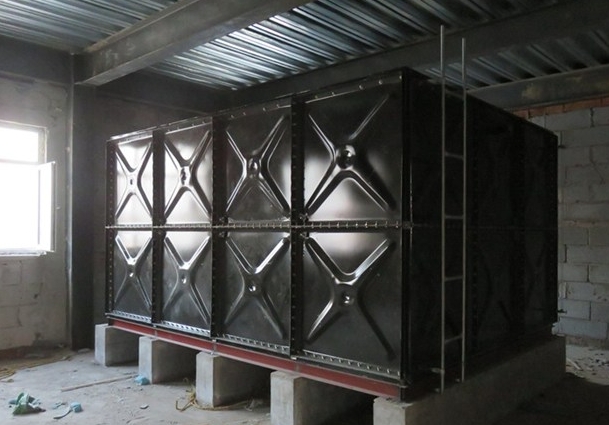
Modular tanks require panel assembly. Using food-grade gaskets and bolted connections, assembled tanks must undergo a hydrostatic test: filled with water and held for 24-48 hours to check for leaks at seams and to ensure sidewall deflection remains within standard limits (e.g., not exceeding 1% of the tank height). Every tank from Beijing Yuanhui undergoes this final inspection, accompanied by a detailed test report.
4. Quality Control and Industry Outlook
A quality control system integrated throughout the entire process is the core of manufacturing reliable FRP tanks. From raw material inspection (resin viscosity/acid value, fiber moisture content) to in-process checks of gel time and cure degree, and finally to finished product tests like wall thickness measurement (ultrasonic gauge) and mechanical property sampling, every step must be documented and verifiable.
A case in point is Beijing Yuanhui FRP Co., Ltd.'s project supplying 12 units of 500-cubic-meter fire water tanks for a large industrial park. By strictly adhering to the aforementioned processes, the tanks' interior gel coat remained intact and Barcol hardness stable after five years of service, with no reported leaks, fully validating the value of a mature manufacturing process.
Looking ahead, FRP tank manufacturing is evolving towards greater environmental friendliness (e.g., low-styrene-emission resins), smarter production (in-line process monitoring), and higher performance (anti-aging, self-cleaning). However, regardless of technological advancements, respect for and strict adherence to fundamental process details remain the only way to produce durable, safe, and reliable FRP water tanks.