A Comprehensive Analysis of the FRP Water Tank Production Process: From Raw Materials to Finished Product
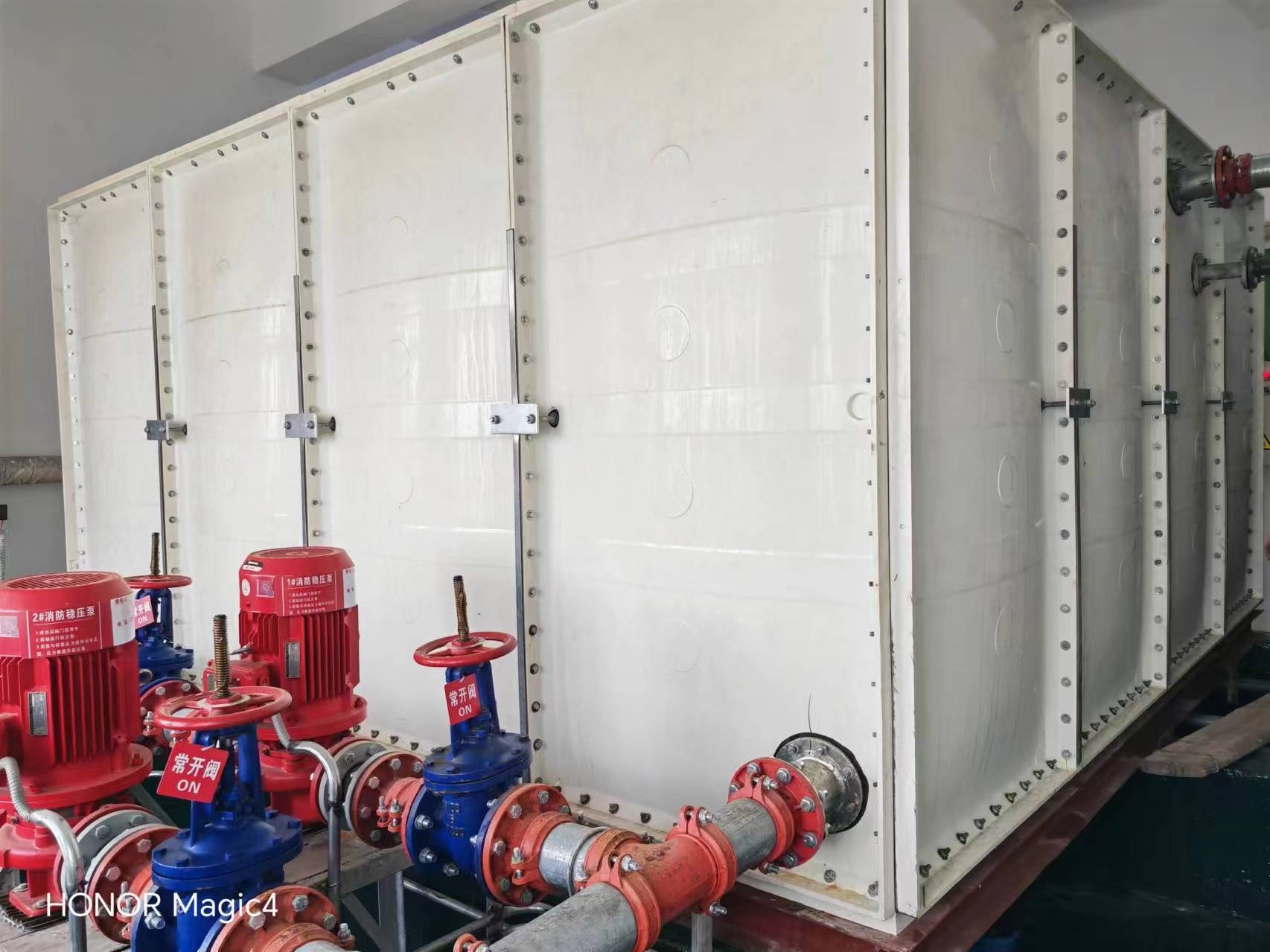
A Comprehensive Analysis of the FRP Water Tank Production Process: From Raw Materials to Finished Product
Fiber Reinforced Plastic (FRP) water tanks are pivotal in secondary water supply and firewater storage due to their superior corrosion resistance, high strength-to-weight ratio, and long service life. These advantages are fundamentally rooted in a meticulous and scientific production process. A complete FRP tank manufacturing cycle is far more than simply "brushing resin and laying fiberglass"; it is a systematic engineering project integrating materials science, structural mechanics, and process control. This article deconstructs this流程 to reveal the manufacturing logic behind high-quality tanks.
I. Production Preparation & Mold Technology: The Foundation of Quality
Production begins with the mold, whose precision directly dictates the dimensional stability and surface finish of the tank panels. The industry predominantly uses female molds, typically made of FRP or precision-machined wood/metal. The mold surface undergoes multiple stages of polishing and is coated with a high-quality release agent (e.g., PVA or semi-permanent wax) to ensure easy demolding and a smooth gel coat finish.
1.1 Raw Material Selection & Inspection
Core materials include unsaturated polyester resin and alkali-free glass fiber products (chopped strand mat, woven roving, surface veil). For instance, Beijing Yuanhui FRP Co., Ltd. typically uses food-grade isophthalic polyester resin compliant with relevant standards for potable water tanks, ensuring water safety. Resin viscosity, gel time, and solid content are strictly tested before use. Glass fiber must exhibit good wettability and high strength, with moisture content below 0.1%.
II. Core Forming Processes: The Craft of Hand Lay-up and Filament Winding
FRP tank panels are primarily manufactured using the hand lay-up process, while cylindrical tank bodies may utilize filament winding technology. Hand lay-up remains the mainstream for modular panel tanks.
2.1 Hand Lay-up Process Flow
The process starts with applying a resin-rich gel coat (approx. 0.25-0.4mm thick) onto the clean mold, forming the first barrier against corrosion and permeation. After the gel coat gels, the structural lamination begins: typically, a layer of surface veil is laid first to create a resin-rich layer and prevent fiber pattern print-through. This is followed by the alternating lay-up of chopped strand mat (CSM) and woven roving (WR). CSM provides good isotropic strength and smoothness, while WR offers high directional strength. Each layer must be meticulously rolled with a roller to eliminate air bubbles and ensure complete fiber wet-out. This sequence is repeated to achieve the design thickness (usually a minimum of 8mm per panel).
2.2 Structural Laminate Design & Cure Control
A standard 1m×1m tank panel laminate may consist of a sequence like "1 layer surface veil + 2 layers of 300g CSM + 1 layer of 800g WR." The resin content must be controlled between 50%-55%. Curing is an exothermic reaction, requiring an ambient temperature of 15-30°C and humidity below 80%. Beijing Yuanhui's workshop employs constant temperature and humidity control to ensure complete resin cure, achieving a Barcol hardness above 40, thus preventing later deformation or insufficient strength.
III. Post-Processing, Assembly & Inspection: The Closed Loop of Precision
Post-cured panels undergo rigorous finishing before becoming qualified products.
3.1 Demolding & Trimming
Panels are demolded after achieving sufficient strength in the mold (typically after 24 hours). Trim edges are then cut and sanded to remove flash, and installation/overflow holes are precisely drilled. All cut edges must be sealed with resin to prevent fiber exposure and water wicking.
3.2 Assembly & Sealing
On-site tank assembly utilizes bolted connections. Sealing is critical; gaskets must be non-toxic, aging-resistant, food-grade silicone or EPDM rubber. Bolts are tightened progressively and uniformly in a diagonal sequence, with torque typically controlled at 25-30 N·m. Overtightening can cause stress concentration and panel cracking.
3.3 Quality Inspection & Hydrostatic Testing
Each finished panel is inspected for appearance, dimensions, and Barcol hardness. Upon complete assembly, the tank must undergo a full hydrostatic test: filled with water and held for 24-48 hours to check all seams for leakage and the structure for significant deflection. According to national standards, deflection should not exceed 0.5% of the tank height. Beijing Yuanhui FRP Co., Ltd. provides an independent test report with each tank as part of the delivery documentation.
Conclusion
The production of FRP water tanks is a precise, interlinked process where every step—from the exacting standards of mold preparation, through the perfect impregnation of resin and fiber, to the meticulous details of assembly and sealing—directly impacts the final product's performance and lifespan. With ongoing material upgrades and process advancements (such as the introduction of semi-automated processes like vacuum infusion), FRP tank manufacturing is evolving towards greater efficiency and consistency. For end-users, understanding this full production流程 is essential for discerning product quality and making informed procurement and maintenance decisions. Choosing a manufacturer like Beijing Yuanhui FRP Co., Ltd., which adheres to rigorous process standards, ultimately means choosing water supply safety and reliability that stands the test of time.