Seismic Performance Analysis and Key Design Specifications for FRP Water Tanks
Seismic Performance Analysis and Key Design Specifications for FRP Water Tanks
Earthquake damage to water supply systems directly impacts post-disaster rescue and recovery. As critical water storage equipment, the seismic performance of Fiber Reinforced Plastic (FRP) water tanks is paramount. Their unique material properties and structural configuration offer distinct advantages under seismic loads, yet adherence to rigorous design and construction codes is essential to ensure safety.
Seismic Advantages and Mechanical Properties of FRP Materials
FRP is a composite material consisting of glass fiber reinforcement and a polymer resin matrix. Its seismic performance stems from high specific strength and specific stiffness. For instance, the alkali-free glass fibers and food-grade resin commonly used yield tensile strengths exceeding 300 MPa, while the density is only about one-quarter that of steel. This lightweight, high-strength characteristic significantly reduces the seismic inertial forces acting on the tank body during an earthquake.
More importantly, the anisotropic nature of FRP allows for design optimization. Through filament winding processes, fiber layup can be tailored to address hoop stress and axial bending moments. In seismic design, localized reinforcement at the tank bottom, panel joints, and around openings—such as increasing fiber layers or employing cross-helical winding—ensures a rational stiffness distribution, preventing brittle failure from stress concentrations. The material's inherent damping ratio is also higher than concrete, aiding in dissipating seismic energy.
Key Elements of Seismic Structural Design
The seismic capacity of an FRP water tank is a synthesis of material performance and structural design.
1. Tank Structure and Joint Design
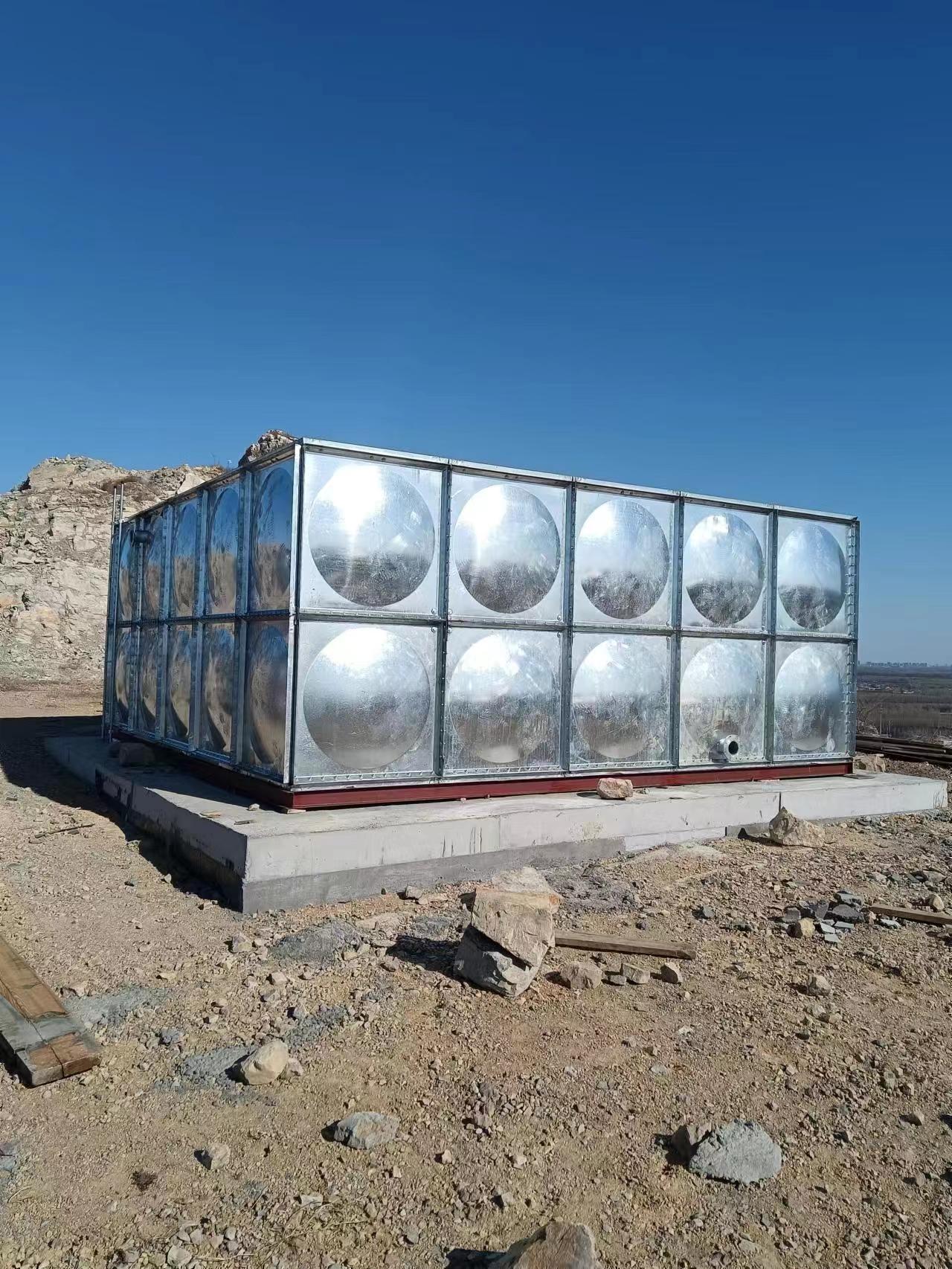
For modular panel-type tanks, the seismic vulnerability lies in the sealed connections between panels. Engineering practice demonstrates that a flexible connection system using high-strength bolts with EPDM rubber gaskets is critical. This system allows for minor relative displacement between panels, absorbing deformation energy rather than resisting it rigidly. Design must calculate the shear force at connections per relevant seismic codes and ensure bolt specifications and spacing meet requirements.
2. Foundation and Anchorage System
The principle of "strong anchorage, weak tank" is fundamental. Tanks must be securely anchored via embedded or chemical anchor bolts to a seismically designed concrete foundation or steel support. Anchorage design must consider overturning moments and uplift forces. For example, a 100-cubic-meter rectangular tank in a seismic zone with a 0.2g design acceleration may require corner anchors to resist uplift forces over 20 kN. The foundation itself must possess sufficient rigidity and integrity to prevent differential settlement.
3. Internal Tie-Rods and Bracing System
Large-capacity tanks (typically single compartments exceeding 50 m³) require an internal stainless steel tie-rod system. Tie-rods not only resist hydrostatic pressure but also effectively restrain tank deformation during earthquakes, mitigating "sloshing effects." The density, diameter, and pre-tensioning of tie-rods require specialized calculation via finite element analysis or standard drawings.
Governing Design Codes and Standards
Professional seismic design for FRP water tanks must strictly adhere to a multi-tiered standard system.
National mandatory codes form the basis: the Code for Seismic Design of Buildings provides fundamental methods for calculating seismic actions. Industry product standards, such as those for FRP water tanks, specify requirements for materials, structure, and performance. In detailed design, the mode-superposition response spectrum method is typically used to calculate seismic actions for frequent earthquakes, with elastoplastic deformation checks for key components under rare earthquakes.
International standards like AWWA D120 and API 650, though for metal tanks, offer valuable references for FRP tank seismic analysis, particularly regarding hydrodynamic pressure calculation (convective and impulsive components) and anchorage design principles. These are often consulted for high-standard domestic or export projects to ensure robustness.
Case Studies and Performance Validation
Practice is the ultimate test of seismic design. For a hospital project in a high seismic intensity zone (design acceleration 0.2g) in Sichuan, two 150-cubic-meter rectangular FRP water tanks were designed and installed. The design phase employed ANSYS software for time-history analysis, simulating stress and displacement responses under seismic waves like El-Centro and Wenchuan records. Results showed that under rare earthquake scenarios, maximum stress occurred at the lower corners but remained well below material allowable limits, with anchorage safety factors exceeding 2.0.
Construction emphasized foundation and anchor bolt quality, using torque wrenches for graded, symmetrical tightening of all connection bolts. The tanks have operated safely for years, withstanding several felt earthquakes, validating their seismic performance. Furthermore, shake-table testing in laboratories provides direct observation of dynamic response and failure modes, offering data to optimize design.
Conclusion
The superior seismic performance of FRP water tanks is not inherent but is built upon a deep understanding of material science, precise structural mechanics calculation, and strict adherence to codes and standards. Every detail—from oriented reinforcement via fiber winding, to flexible joint detailing, to reliable anchorage design—impacts water storage safety during earthquakes. As design specifications evolve and computational simulation advances, the seismic design of FRP tanks is moving towards greater refinement and reliability. For owners and engineers, partnering with suppliers possessing proven expertise in seismic design and implementation is crucial for ensuring the functionality of lifeline infrastructure during seismic events.