Analysis of Seismic Performance and Key Design Specifications for FRP Water Tanks
Analysis of Seismic Performance and Key Design Specifications for FRP Water Tanks
The integrity of water supply systems post-earthquake is critical for disaster response and recovery. As a key water storage facility, the seismic performance of Fiber Reinforced Plastic (FRP) water tanks is of paramount importance. Their unique material properties and structural design make them a vital component in the seismic resilience of modern buildings and infrastructure.
Seismic Advantages and Mechanical Properties of FRP Material
The seismic resilience of FRP stems from its composite nature. Compared to traditional concrete or steel tanks, FRP tanks are notably lightweight and high-strength. With a density of 1.5-2.0 g/cm³, they are approximately one-quarter the weight of steel and one-third that of concrete. Since inertial forces during an earthquake are proportional to mass, this weight reduction directly decreases seismic loads.
More crucially, FRP material exhibits good elasticity and high tensile strength. Taking the food-grade resin and alkali-free glass fiber winding process employed by Beijing Yuanhui FRP Co., Ltd. as an example, the resulting tank panels can achieve a tensile strength exceeding 200 MPa. Although its elastic modulus is lower than steel, its elongation at break is superior to brittle materials. When seismic events induce deformation, FRP can absorb and dissipate energy through elastic deformation, rather than undergoing immediate brittle failure. This characteristic of "flexibility overcoming rigidity" is central to its seismic performance.
Seismic Structural Design and Key Code Interpretation
Superior material properties must be translated into reliable seismic resistance through scientific structural design. The seismic design of an FRP water tank is a systematic engineering task.
Structural System and Connection Design
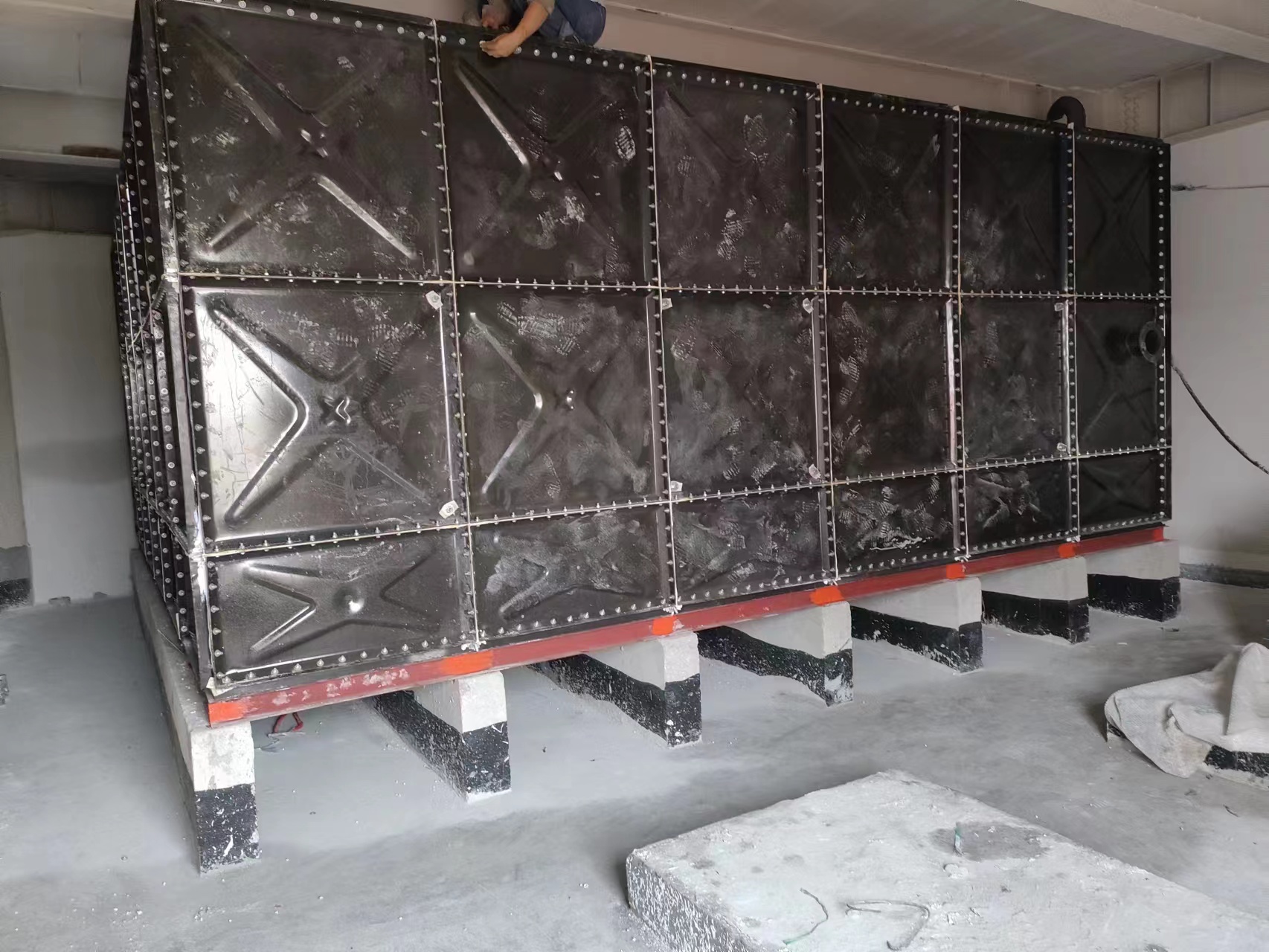
For modular assembled tanks, the connections between panels are potential seismic weak points. Codes require the use of high-strength, food-grade sealing gaskets combined with bolts. Bolt spacing typically should not exceed 200mm, and anti-loosening measures are necessary. Large tanks must be equipped with an internal bracing system (tie rods, columns) designed to withstand lateral forces from both hydrostatic and hydrodynamic pressures under the design seismic intensity.
Code Compliance and Load Calculation
Design in China primarily follows the "Code for Seismic Design of Buildings" (GB 50011) and the "Code for Structural Design of Water Supply and Wastewater Engineering Structures" (GB 50069). Design must consider multiple load combinations including dead load, water pressure, wind load, and seismic action. Seismic load calculation must include both horizontal and vertical components, with hydrodynamic pressure being a critical focus. According to Housner's theory, water sloshing during an earthquake generates impulsive and convective pressures, directly impacting stresses on tank walls and internal supports.
In a project for a key hospital located in a seismic intensity 8 zone, Beijing Yuanhui FRP Co., Ltd. not only performed standard seismic calculations but also conducted dynamic time-history analysis using finite element software on the full tank model. This allowed for optimization of the tie-rod layout, ensuring the performance objective of "no collapse under a rare earthquake."
Engineering Practices and Seismic Performance Enhancement Measures
Theoretical design and code requirements must be implemented in practice. Measures to enhance the seismic performance of FRP tanks span selection, installation, and maintenance.
Foundation and Anchorage: The tank foundation must be level, solid, and monolithic. Rubber pads are usually installed between the foundation and tank base plate for vibration damping. The diameter, embedment depth, and pull-out resistance of anchor bolts require rigorous calculation. Post-earthquake surveys, such as after the 2017 Jiuzhaigou earthquake, showed significantly higher survival rates for properly anchored FRP tanks compared to those with foundation flaws.
Installation Process Control: Verticality during assembly, uniformity of gaps between panels, and bolt tightening torque must be strictly controlled. Improper installation introduces initial stresses that can severely compromise overall seismic integrity.
Innovative Structural Applications: For sites with extremely high seismic demands, cylindrical tanks are often preferred. Their symmetrical shape ensures uniform force distribution, generally offering better seismic performance than rectangular tanks. Furthermore, the use of panels with integrally molded, three-dimensional reinforcing ribs can effectively improve local stiffness and stability.
Conclusion
The seismic performance of FRP water tanks results from the synergy of material advantages, rigorous design codes, and precise construction practices. Their inherent properties of being lightweight, strong, and elastic provide a natural advantage for seismic resistance. Strict adherence to seismic design codes and scientific load analysis and structural design are the core safeguards for their safety. Every step—from material selection and modular connection to internal bracing and foundation anchorage—must be guided by seismic principles. With the continuous improvement of design specifications and the technical expertise accumulated by specialized enterprises like Beijing Yuanhui FRP Co., Ltd., modern FRP water tanks are fully capable of meeting the seismic performance requirements of high-intensity zones, providing a robust guarantee for the reliability of lifeline engineering. Ongoing attention to material innovation and前沿 research in seismic design remains a crucial direction for the industry to enhance the overall safety of FRP tanks.