Seismic Performance Analysis and Key Design Specifications for FRP Water Tanks
Seismic Performance Analysis and Key Design Specifications for FRP Water Tanks
Earthquake damage to water supply systems directly impacts post-disaster rescue and recovery. As the core water storage unit, the seismic performance of Fiber Reinforced Plastic (FRP) water tanks is critical. Their reliability depends not only on the material properties but also on scientific design codes, structural calculations, and construction techniques.
Seismic Performance Mechanism and Advantages of FRP Tanks
The seismic resilience of FRP tanks stems from unique material and structural characteristics. FRP offers a high strength-to-weight ratio, with tensile strength exceeding 300MPa while its density is only about one-quarter that of steel. Since inertial forces during an earthquake are proportional to mass, this lightweight nature significantly reduces seismic loads.
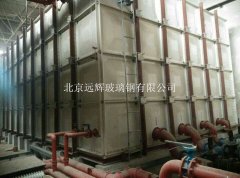
From a structural dynamics perspective, FRP tanks are typically thin-walled shell structures. Their seismic performance is achieved through: firstly, the inherent elasticity and toughness of the composite material, which absorbs and dissipates seismic energy; secondly, the monolithic or optimally modular design ensuring structural integrity, avoiding stress concentration and brittle failure. Engineering tests by Beijing Yuanhui FRP Co., Ltd. show that rib-reinforced panel designs effectively distribute stress and minimize deformation under simulated seismic waves.
Core Design Codes and Standards Analysis
The design of FRP water tanks must adhere to stringent seismic codes, which form the basis of their safety.
Chinese National and Industry Standards
Domestic design primarily follows the Code for Seismic Design of Buildings (GB 50011) and the Code for Structural Design of Water Supply and Wastewater Engineering Structures (GB 50069). These codes require treating the tank as a non-structural component or ancillary equipment for seismic calculation, focusing on horizontal seismic action. Calculations must consider seismic loads from the tank structure, supports, and hydrodynamic pressure (water sloshing). For FRP material, the Technical Code for Fiber Reinforced Plastics Equipment and Piping Engineering (GB 51160) is also referenced for material performance factors and long-term durability.
International Standards Reference
International standards like AWWA D120 (Standard for Thermosetting Fiberglass-Reinforced Plastic Tanks) and Japanese JWWA K103 provide more detailed guidance. AWWA D120, for instance, specifies clear load combinations, allowable stress checks, and connection details for seismic design, with particular emphasis on anchorage systems and foundation connections.
Key Design Considerations for Enhancing Seismic Performance
Based on code requirements, professional FRP tank design focuses on several critical aspects.
Structural Optimization: For modular panel designs, panel thickness must vary with water depth, with the thickest (often ≥12mm) at the bottom. Internal vertical and horizontal stiffeners form a grid structure. Rib dimensions and spacing are determined via Finite Element Analysis (FEA) to resist combined hydrostatic and seismic loads. Beijing Yuanhui FRP Co., Ltd. utilizes CAE simulation for seismic scenarios to optimize rib layout, ensuring stable performance in tests corresponding to seismic intensity VIII.
Anchorage and Foundation System: This is often the most vulnerable point and a primary design focus. The anchorage must transfer both shear and uplift forces. Design involves calculating overturning moments and providing sufficient chemical anchors or embedded steel plates. The foundation must be level and robust to ensure uniform load transfer and prevent differential settlement that induces excessive stress.
Flexible Pipe Connections: The principle of "rigid tank, flexible pipes" is mandatory. Pipes connected to the tank must have stainless steel braided hoses or rubber expansion joints installed near the connection point to prevent pipe rupture due to structural displacement during an earthquake, which could cause secondary damage.
Engineering Practice and Future Outlook
Practice is the sole criterion for validating design. FRP tanks in critical projects like hospitals and schools, designed in strict compliance with seismic codes, have proven their reliability. One project in a high seismic zone, for example, passed a specialized seismic review by employing thicker panels, closer anchor spacing (≤1.5m), and internal tie rods.
The future of FRP tank seismic design lies in greater refinement. Performance-based seismic design concepts will be increasingly applied, potentially combined with real-time monitoring to assess functional sustainability. New materials, such as localized carbon fiber reinforcement, offer novel approaches for strengthening critical sections.
Conclusion
The superior seismic performance of FRP water tanks is not accidental; it results from the integration of material science, structural mechanics, and rigorous engineering codes. Ensuring safety and functionality during earthquakes starts with a deep understanding of seismic mechanisms, strict adherence to design specifications, and focused attention on key details like structural optimization, anchorage, and flexible connections. Professional manufacturers like Beijing Yuanhui FRP Co., Ltd. contribute to urban water supply security by translating code requirements into precise design and manufacturing, building a resilient line of defense.