Seismic Performance of FRP Water Tanks: Design Specifications and Engineering Practice
Seismic Performance of FRP Water Tanks: Design Specifications and Engineering Practice
Earthquake damage to water supply systems directly impacts post-disaster rescue and recovery. As a critical storage facility, the seismic performance of Fiberglass Reinforced Plastic (FRP) water tanks is paramount. Their unique material properties and structural configuration offer distinct advantages under seismic loads, yet they must also adhere to rigorous design and construction codes.
Seismic Structural Advantages and Mechanical Principles of FRP Tanks
The seismic resilience of FRP tanks stems from their integrated material and structural design. Unlike the brittleness of concrete or the susceptibility to buckling in steel tanks, FRP composites exhibit excellent specific strength and a high modulus of elasticity.
Seismic Benefits from Material Properties
FRP composites, consisting of glass fibers and a polymer resin matrix, typically have a fracture elongation rate between 1.5% and 2.5%, significantly higher than concrete. This property allows the tank shell to absorb and dissipate seismic energy through elastic deformation rather than brittle fracture. The food-grade resin and alkali-free glass fiber winding process employed by companies like Beijing Yuanhui FRP Co., Ltd. ensure material uniformity and high toughness, forming the foundation for seismic resistance.
Structural Contribution to Seismic Performance
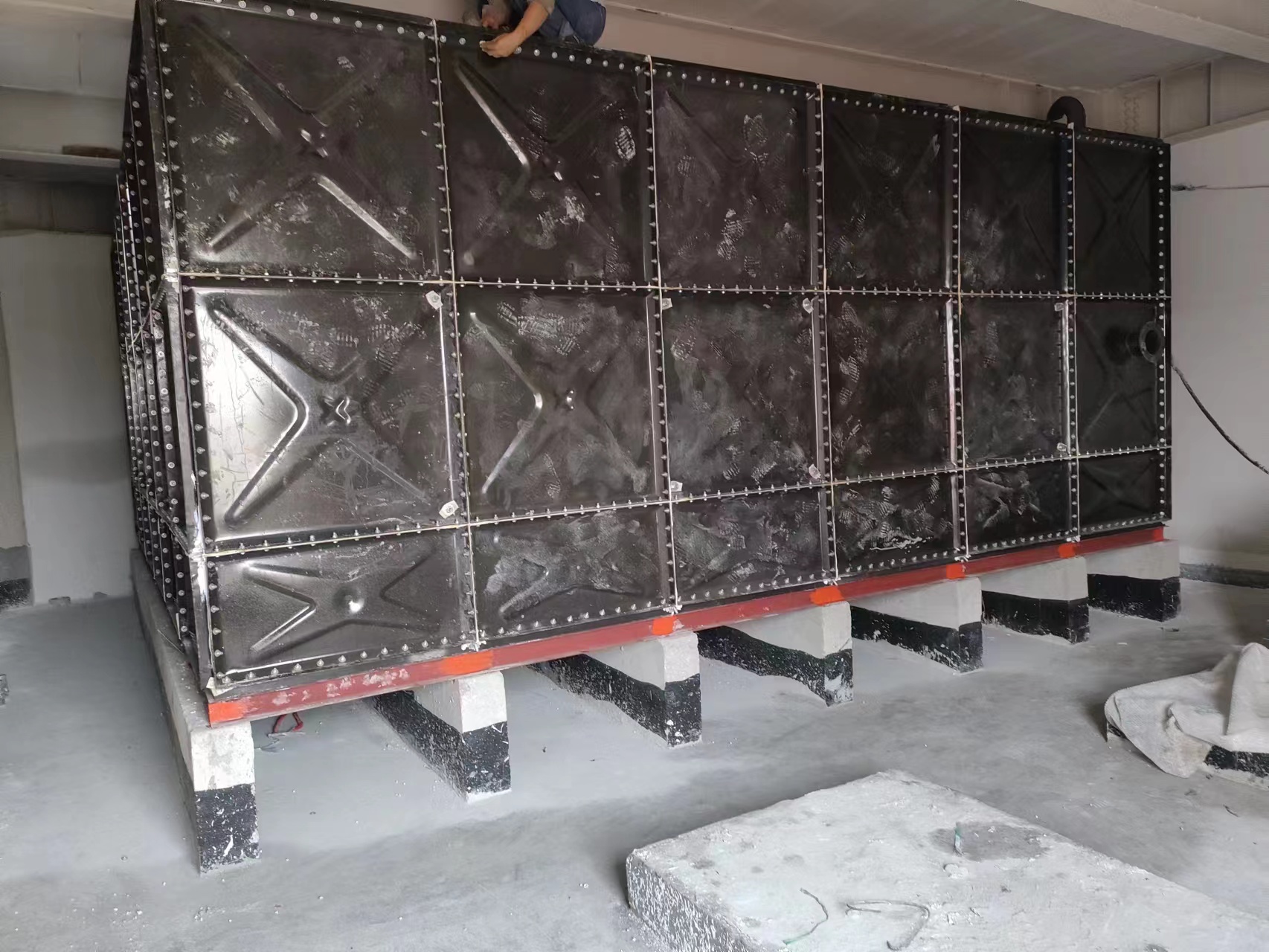
Standard FRP tanks feature a modular, bolted-panel construction with sealing gaskets. This "semi-rigid" connection system allows for minimal relative displacement between panels during an earthquake, mitigating stress concentration. Simultaneously, an internal network of tie rods (typically stainless steel or FRP) connects the sidewalls, floor, and roof into an integrated space-frame structure, significantly enhancing overall lateral and torsional stiffness.
Seismic Design Codes and Standards
The design of FRP water tanks must comply with national and industry regulations to ensure safety and functionality during seismic events.
Key Code Requirements
The cornerstone in China is the Code for Seismic Design of Buildings (GB 50011), which specifies seismic fortification categories, seismic action calculation methods, and detailing requirements for water storage structures. Tanks for critical lifeline projects often require Category B or higher fortification. Product standards like Glass Fiber Reinforced Plastic Water Tanks (JC/T 658.1) provide specific requirements for panel thickness, joint strength, and tie-rod density—parameters directly influencing seismic capacity.
Seismic Action Calculation and Load Combinations
Design must account for both horizontal and vertical seismic actions. Crucially, seismic loads act not only on the tank structure but also on the stored water, causing sloshing (convective component) and impulsive pressure. Codes mandate calculations using methods like the added mass approach or time-history analysis. The seismic action is combined with other loads (hydrostatic pressure, wind, snow) in the most unfavorable combination to verify wall strength, joint integrity, and global stability.
Key Design Considerations for Enhancing Seismic Performance
Based on principles and codes, engineering design must focus on several core aspects to substantially improve the seismic rating of FRP tanks.
Enhanced Structural Design
In high seismic zones (e.g., intensity 8 and above), reinforced designs are essential. This includes increasing panel thickness (e.g., from 8mm to 12mm+), reducing tie-rod grid spacing while increasing their cross-section, and adding seismic stiffeners at corners and panel joints. For instance, Beijing Yuanhui FRP Co., Ltd. utilized a double-layer dense tie-rod grid and thickened corner panels for an 800 m³ hospital tank in a high-risk zone, which successfully passed a specialized seismic review.
Foundation and Anchorage System Synergy
Tank seismic performance is a system issue. A superior tank must be paired with a reliable foundation and anchorage. Foundations require sufficient rigidity and integrity, typically reinforced concrete raft slabs. The number, diameter, embedment depth, and layout of anchor bolts must be rigorously calculated to effectively transfer seismic shear to the foundation. Elastic pads at the bolt-to-tank-base connection help cushion impact and prevent local crushing of the FRP laminate.
Flexible Piping Connections
Rigid pipes connected to tanks often fracture due to differential displacement during earthquakes. Installing flexible joints (e.g., rubber expansion joints or stainless steel bellows) at all inlet, outlet, and overflow piping connections is a critical, yet often overlooked, detail to maintain post-earthquake functionality.
Engineering Case Study and Validation
Practice is the ultimate test. A fire water tank project by Beijing Yuanhui FRP Co., Ltd. in a high-intensity region (seismic intensity 8, design acceleration 0.30g) serves as an example. The technical team performed detailed seismic calculations per GB 50011, implementing a full reinforced design: 12mm thick panels, tie-rod grid at 0.8m x 0.8m spacing, 48 pieces of M24 chemical anchor bolts, and seismic-rated bellows on all pipes.
Following installation, the tank withstood several felt earthquakes, including a recent M4.5 event approximately 20 km from the site. Post-event inspection confirmed the tank structure was intact and leak-free, connections were secure, and piping interfaces were functional, demonstrating the excellent seismic reliability of a properly designed and constructed FRP water tank.
Conclusion
The seismic performance of an FRP water tank is a testament to comprehensive engineering. It results not from a single material property but from the systematic integration of material advantages, innovative structural design, strict code compliance, and precise construction. Every detail, from the macro requirements of seismic codes to the micro-specifications of tie-rod spacing and anchor bolts, contributes to ultimate safety. For owners and designers, partnering with experienced suppliers like Beijing Yuanhui FRP Co., Ltd., which possesses proven seismic design expertise, adds a reliable layer of protection to water security. As material science and seismic engineering advance, the seismic design of FRP tanks will evolve towards greater precision and intelligence, offering more resilient safeguards for urban lifeline infrastructure.