A Comprehensive Analysis of the FRP Water Tank Manufacturing Process
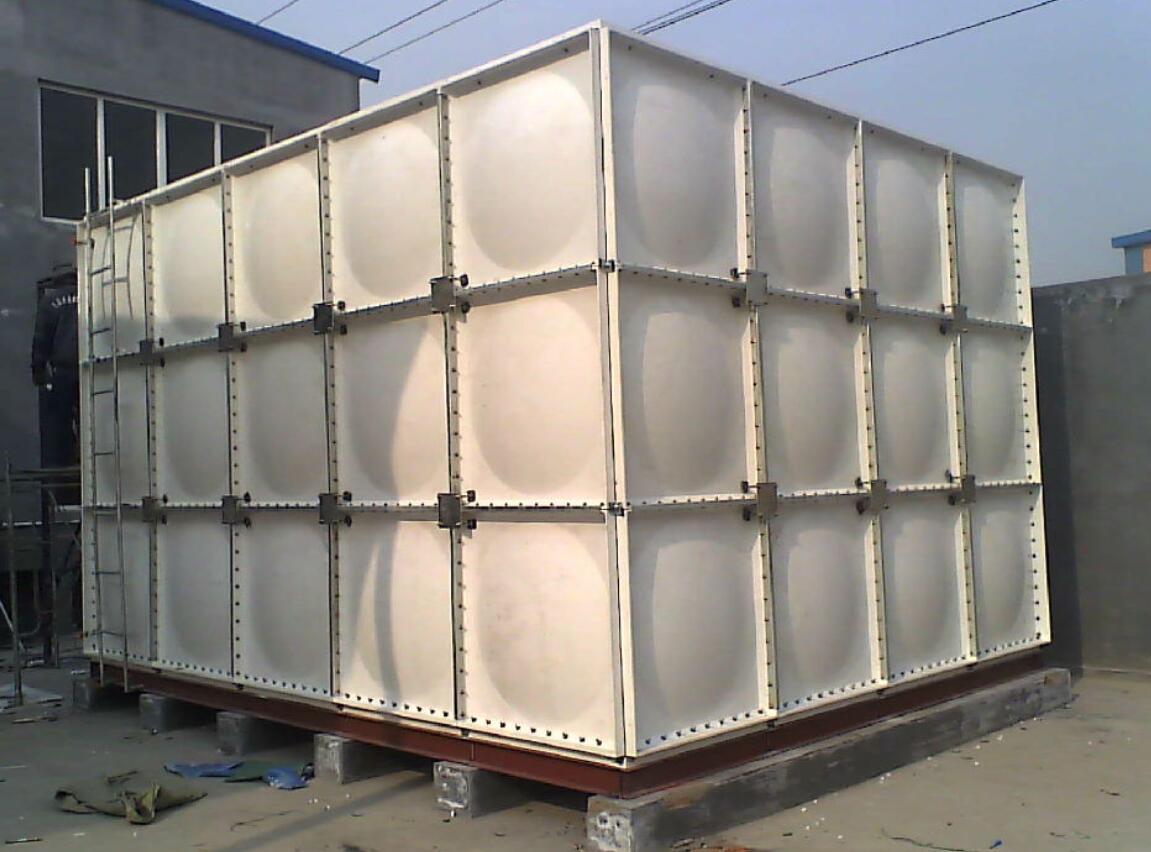
A Comprehensive Analysis of the FRP Water Tank Manufacturing Process
Fiber Reinforced Plastic (FRP) water tanks are core equipment in industrial and civil water storage due to their superior corrosion resistance, high strength-to-weight ratio, and long service life. The creation of a high-quality tank relies on a rigorous and scientific manufacturing process system. Drawing on over two decades of industry experience, Beijing Yuanhui FRP Co., Ltd. has established a standardized and refined production workflow, from raw material selection to on-site installation.
1. Production Preparation and Mold Treatment
The manufacturing process begins not with the tank itself, but with meticulous preparation. The quality of the mold directly determines the dimensional accuracy and inner surface finish of the tank panels. Beijing Yuanhui typically employs high-precision steel or dedicated FRP molds with flatness errors strictly controlled within ±0.5mm/m.
1.1 Mold Cleaning and Release Agent Application
The mold must be thoroughly cleaned before each use to remove residual resin and dust. Subsequently, a high-efficiency release agent (such as polyvinyl alcohol or wax-based) is applied evenly, usually in 2-3 coats, ensuring a continuous, uniform film. This step is critical for successful demolding and achieving a flawless, smooth surface.
1.2 Raw Material Inspection and Formulation
Key raw materials include unsaturated polyester resin (e.g., isophthalic or vinyl ester, depending on corrosion resistance requirements), alkali-free glass fiber rovings and mats, catalyst (e.g., methyl ethyl ketone peroxide), and promoter. Beijing Yuanhui's QC department tests each batch of resin for viscosity and gel time, and glass fibers for moisture content, ensuring compliance with FRP water tank standards. The ratio of resin to catalyst system is precisely calculated based on ambient temperature and humidity, with an error margin within ±1%.
2. Core Molding Processes: Hand Lay-up and Spray-up
The forming of the tank panels is the heart of the FRP tank manufacturing process. The primary methods for ensuring high quality are hand lay-up combined with spray-up.
2.1 Gel Coat Application
A layer of water-resistant gel coat resin, approximately 0.4-0.6mm thick, is first sprayed or brushed onto the prepared mold. Once cured, this layer becomes the inner liner of the tank, directly contacting the stored water. Its integrity defines the baseline performance for leak prevention and corrosion resistance.
2.2 Structural Lamination
After the gel coat gels, the structural lamination begins. Workers lay up pre-cut layers of glass fiber mat and woven roving alternately according to the design thickness (typically 8-12mm per panel). Resin rollers are used to meticulously impregnate the fibers and remove air bubbles. According to Beijing Yuanhui's specifications, the resin content should be controlled between 50%-55%, with overlaps between fiber layers being no less than 50mm. Local reinforcement, such as directional fiber placement or increased thickness, is applied to load-bearing areas of large tanks.
2.3 Spray-up Process Assistance
For批量 production of flat panels, a spray-up chopper gun can be used to simultaneously deposit chopped fibers and resin onto the mold, improving efficiency. However, hand lay-up retains an advantage for精细 control at complex areas like corners and pipe connections, leading to the common "spray-and-lay" combined approach.
3. Curing, Demolding, and Post-Processing
The molded parts enter a strict phase of curing and post-processing.
3.1 Curing Process Control
The laminated panels must cure in a temperature-controlled workshop (recommended 20-25°C). Initial curing typically takes 2-4 hours. After demolding, post-curing is essential for at least 7 days to allow the resin to achieve optimal properties. Beijing Yuanhui's workshops are equipped with environmental monitoring systems to ensure stable curing conditions.
3.2 Demolding and Trimming
After full initial cure, specialized tools are used for careful demolding. The demolded panels are then trimmed and sanded to ensure precise dimensions and smooth edges. All cut-outs (e.g., for inlets, outlets, overflow) are precision-made according to drawings at this stage, with edges sealed with additional resin for enhanced integrity.
3.3 Assembly Component Preparation
Assembly components are prepared: sealing gaskets (typically food-grade rubber or EPDM), bolts (stainless steel 304 or 316), and tie rods. Metal inserts, treated for corrosion resistance, are embedded in the edges of each panel during lamination for subsequent connection.
4. On-Site Assembly and Final Inspection
The final step for modular FRP water tanks is completed at the customer's site.
4.1 Foundation Inspection and Base Panel Installation
The concrete foundation is inspected before installation, with a flatness requirement of ±3mm. Base panels are assembled in sequence on the foundation, with sealant applied to joints and compressed with gaskets.
4.2 Side Panel Assembly and Structural Reinforcement
Side panels are connected sequentially with bolts, layer by layer from bottom to top. Internal and external tie rods are installed simultaneously, creating a grid-like support structure crucial for withstanding water pressure. Beijing Yuanhui engineers use torque wrenches to ensure all bolts are tightened to the specified torque (e.g., 45-50 N·m).
4.3 Water-Fill Test and Final Acceptance
Upon completion, the tank must undergo a water-fill test for at least 24 hours. All joints are inspected for leaks, and the structure is checked for significant deflection. For instance, a 100-cubic-meter FRP water tank should not exhibit a maximum sidewall deflection exceeding 0.5% of its height when full. Final acceptance and delivery are contingent upon passing this test.
Conclusion
The production of an FRP water tank is an interconnected系统工程. Every stage—from mold preparation, material formulation, and molding control to post-curing and on-site assembly—directly impacts the final product's performance and lifespan. The practice of Beijing Yuanhui FRP Co., Ltd. demonstrates that only through standardized operations, refined management, and strict quality inspection can safe, durable, and reliable FRP water tank products be manufactured. These products meet diverse storage needs and ensure water safety. A deep understanding of this complete FRP water tank manufacturing process provides essential guidance for industry professionals aiming to enhance product quality and drive technological advancement.