A Comprehensive Analysis of the FRP Water Tank Manufacturing Process
A Comprehensive Analysis of the FRP Water Tank Manufacturing Process
Fiber Reinforced Plastic (FRP) water tanks are essential in modern water supply systems due to their high strength-to-weight ratio, corrosion resistance, long service life, and hygienic properties. These advantages are realized through a meticulous, standardized manufacturing process. This article provides a detailed breakdown of the complete FRP tank production cycle, referencing the established practices of Beijing Yuanhui FRP Co., Ltd.
1. Preliminary Preparation and Mold Engineering
The foundation of a high-quality tank lies in precise preparatory work, focusing on material selection and mold fabrication, which determine the dimensional accuracy and baseline quality of the final product.
1.1 Raw Material Selection and Inspection
Key raw materials include resin, glass fiber, and additives. Beijing Yuanhui typically employs food-grade unsaturated polyester resin (e.g., isophthalic type) with strict control over styrene residue (<0.1%). Reinforcement materials like medium-alkali or E-glass fiber mats and woven rovings are used, with moisture content kept below 0.2%. Incoming materials are batch-tested against standards like GB/T 8237 to ensure viscosity, gel time, and mechanical properties meet specifications.
1.2 Mold Design and Fabrication
The mold is critical for shaping. For standard modular SMC tanks, high-precision modular molds are required. Constructed from quality wood or metal, the mold surface undergoes extensive polishing and application of high-gloss release agents to achieve a mirror-like finish on the tank's inner surface, preventing biofilm growth. Dimensional tolerance is controlled within ±0.5mm, crucial for seamless panel assembly later.
2. Core Forming Processes: Hand Lay-up and Compression Molding
Two primary forming methods are used: hand lay-up and compression molding, chosen based on tank type and performance requirements.
2.1 Hand Lay-up Process
This method suits large or custom one-piece tanks. The process involves applying a resin-rich gel coat (0.4-0.6mm) onto the prepared mold. After gelling, layers of fiber mat/roving are alternately laid and impregnated with resin using rollers to remove air bubbles. A standard wall may consist of 6-8 layers, with resin content maintained at 50%-55% for optimal strength-corrosion balance. Skilled technicians at Beijing Yuanhui reinforce stress-concentration areas like corners and openings through strategic ply orientation.
2.2 Compression Molding (SMC Process)
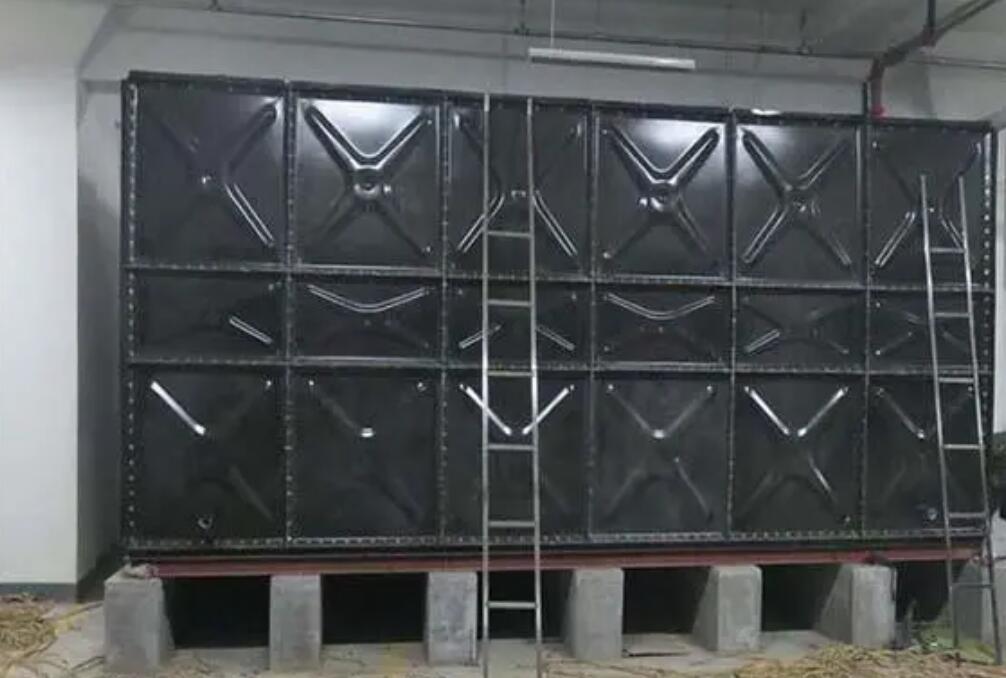
Panels for bolted tanks are often made via Sheet Molding Compound (SMC) compression molding. This automated process offers high consistency. Pre-weighed SMC charges (a blend of resin, chopped fibers, fillers) are placed into heated, matched metal dies and formed under high pressure (10-20 MPa) and temperature (120-150°C). The resulting panels are dimensionally precise, strong, smooth on both sides, and produced rapidly—panels for a 100-ton tank can be molded in minutes.
3. Post-Processing and Quality Assurance System
Demolded parts undergo rigorous post-processing and inspection before certification.
3.1 Post-Curing and Finishing
Parts are post-cured at a controlled temperature (~25°C) for at least 7 days to ensure complete resin cure and design strength. Subsequent steps include trimming flash, smoothing cut edges, and drilling precise bolt holes (<1mm positional error). For hand lay-up tanks, internal seams are reinforced and polished.
3.2 Multi-Stage Quality Inspection
Beijing Yuanhui implements comprehensive testing from raw materials to finished goods. Key tests include: Barcol Hardness (to ensure cure degree, ≥40 required), Water Immersion (assessing resin resistance and leachates), Mechanical Property Testing (flexural/tensile strength per JC/T 658.1-2007), and the final Hydrostatic Leak Test. Every tank must undergo a minimum 24-hour full-water holding test. With strict process control, modern FRP tanks can achieve a service life exceeding 30 years.
4. Site Assembly and Industry Outlook
For modular tanks, factory-produced panels are assembled on-site by specialized crews using food-grade sealing gaskets and stainless steel bolts, followed by a final site hydrostatic test.
Process advancements like filament winding for cylindrical tanks and exploration of Resin Transfer Molding are driving the industry toward larger capacities and integrated smart monitoring. By continuously refining every process detail—from mold making to final inspection—leading manufacturers like Beijing Yuanhui not only ensure product reliability but also steer the industry toward higher standardization and quality. The relentless pursuit of process excellence remains the cornerstone of the FRP water tank's enduring market trust.