Analyzing the Service Life of FRP Water Tanks: Key Influencing Factors and Scientific Maintenance Guidelines
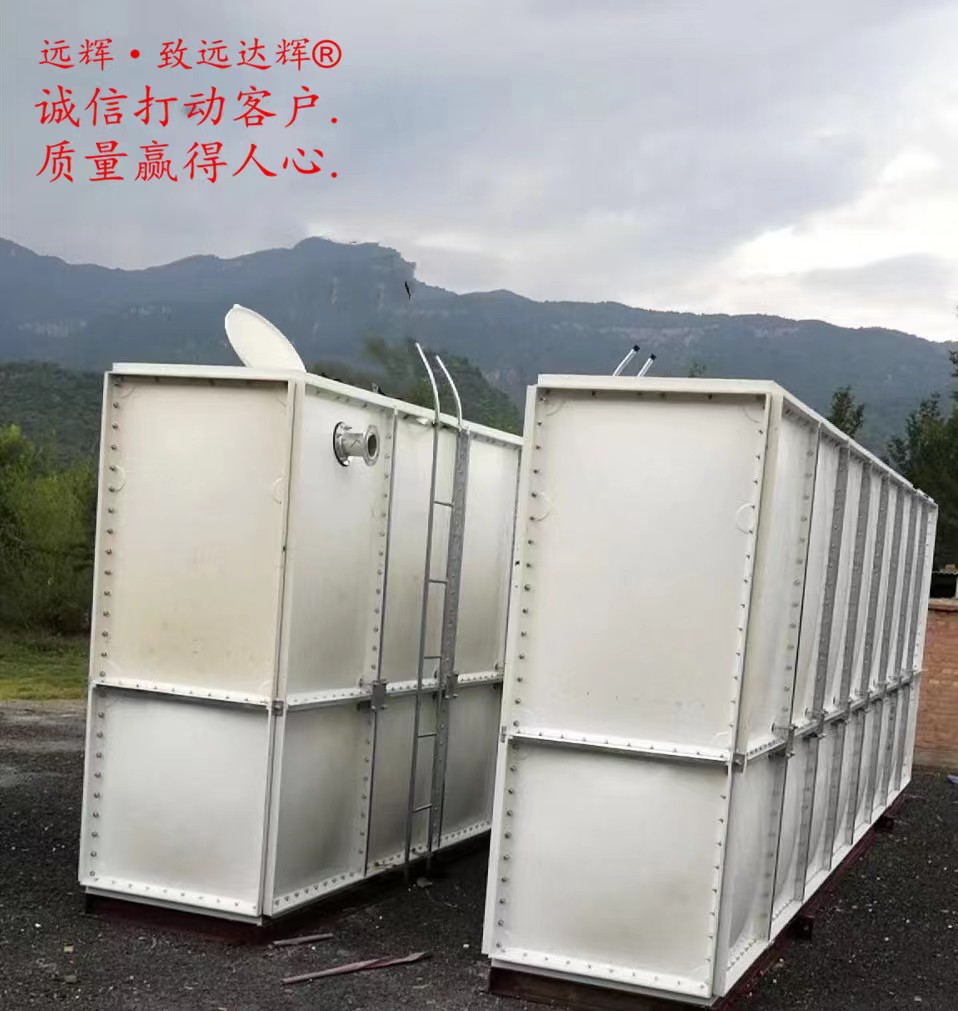
Analyzing the Service Life of FRP Water Tanks: Key Influencing Factors and Scientific Maintenance Guidelines
Fiberglass Reinforced Plastic (FRP) water tanks are widely used in secondary water supply, fire protection, and industrial cooling systems due to their light weight, high strength, and corrosion resistance. One of the most critical concerns for users is their service life. A well-designed, properly manufactured, and meticulously maintained FRP tank can reliably serve for over 25 years, often exceeding 30 years. However, its actual lifespan is influenced by multiple variables, where every stage—from material selection to end-user maintenance—plays a decisive role.
I. Intrinsic Core Factors Determining FRP Tank Lifespan
The "innate quality" of the tank fundamentally sets the upper limit of its service life.
1. Selection of Raw Materials and Resin System
The performance of FRP hinges on its matrix materials—the resin and reinforcing glass fibers. Food-grade unsaturated polyester resins (e.g., isophthalic, vinyl ester) are preferred for high-quality tanks because of their superior water and corrosion resistance. For instance, following the production standards of Beijing Yuanhui FRP Co., Ltd., core products utilize high-grade food-safe resins with content strictly controlled between 50%-55%, ensuring adequate corrosion-resistant liner thickness. The use of medium-alkali or E-glass fibers, along with surface mat and chopped strand mat, is critical for proper wet-out and structural integrity. Inferior resins or low glass content lead to premature micro-cracking, leakage, and strength degradation.
2. Structural Design and Manufacturing Craftsmanship
Sound structural design is essential to withstand long-term hydrostatic pressure and environmental loads. This includes:
- Panel Design: Scientific rib layout and graded thickness distribution (typically 8mm-12mm for standard panels) effectively disperse stress and prevent local deformation. Critical load-bearing areas require additional reinforcement.
- Process Control: Mature hand lay-up or advanced SMC molding must eliminate defects like air bubbles, delamination, or dry spots. Engineering cases from Beijing Yuanhui demonstrate that tanks with multi-layer composite structures (liner, structural layer, external protective layer) and CAD-assisted design exhibit over 40% higher fatigue life compared to conventional designs under similar conditions.
- Connection and Sealing: The quality of gaskets and the bolting procedure for modular tanks are vital for long-term leak-proof performance.
II. Impact of External Environment and Installation Conditions
Even a tank with excellent innate quality can have its lifespan significantly compromised by its operational environment.
1. Medium and Water Quality
The chemical nature of the stored medium is the primary external factor. Storing potable water at ambient temperature is least corrosive. Storing heated water (>45°C) or industrial fluids containing chlorides, acids, or alkalis accelerates resin hydrolysis and aging. For example, long-term storage of reclaimed water or firefighting water may lead to slow microbial and oxidative erosion of the inner liner.
2. Installation Environment and Physical Loads
The foundation must be level, solid, and capable of bearing the design load. Uneven settlement causes stress concentration, leading to structural cracks. For outdoor installations, environmental loads are critical: prolonged UV exposure causes resin surface chalking and degradation, weakening the outer layer; extreme temperature cycling (especially in northern climates) tests the adhesive interfaces and seals due to thermal expansion and contraction. Therefore, outdoor tanks must be equipped with a UV-resistant gel coat or protective shading.
III. Scientific Operation and Maintenance: Key Practices for Lifespan Extension
Proactive, preventive maintenance is central to sustaining optimal tank performance and achieving or exceeding its design life.
1. Establishing Regular Inspection and Cleaning Regimes
A comprehensive inspection is recommended every six to twelve months. This should include checking for visible deformation or cracks, inspecting the inner liner for smoothness, cracking, or fiber exposure, verifying seal integrity for leaks, and ensuring the stability of manways and ladders. Tanks should be cleaned periodically based on water quality to prevent sediment and algae buildup, which can create corrosive conditions under anaerobic states. Use soft tools during cleaning to avoid scratching the liner.
2. Timely Repair and Professional Maintenance
Minor cracks or localized damage should be repaired immediately by contacting professional manufacturers like Beijing Yuanhui FRP Co., Ltd. A proper repair involves surface grinding, cleaning, layered laminate patching, and curing—not simply filling with ordinary adhesive, which can create larger future problems. For tanks in service for over 15 years, consider professional non-destructive testing (e.g., ultrasonic thickness gauging) and safety assessments.
Conclusion
The service life of an FRP water tank is not a fixed number but a dynamic outcome determined by the interplay of material quality, design craftsmanship, installation environment, and maintenance standards. To maximize return on investment, users should select reliable suppliers like Beijing Yuanhui FRP Co., Ltd., who prioritize raw materials and structural design, ensuring quality from the source. During long-term operation, a "prevention-first" maintenance philosophy must be adopted, implementing systematic and professional management to promptly address potential issues. Only by combining superior products with scientific management can FRP water tanks operate safely and reliably for decades, delivering sustained economic and practical value.