Comprehensive Analysis of FRP Water Tank Production Process: Precision Manufacturing from Mold to Finished Product
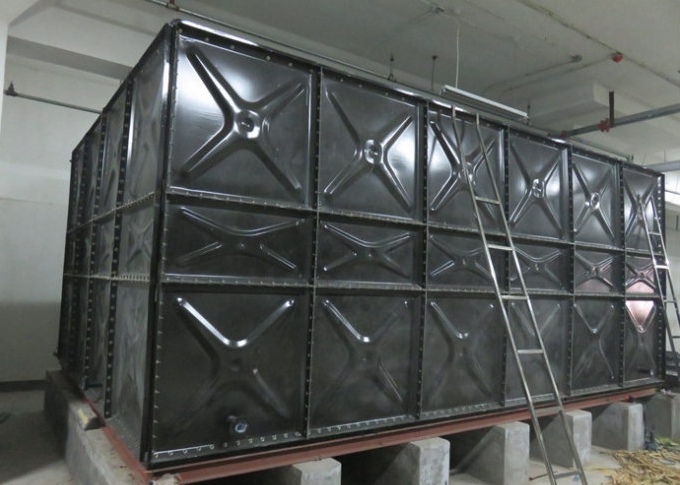
Comprehensive Analysis of FRP Water Tank Production Process
Fiber Reinforced Plastic (FRP) water tanks are critical components in modern water supply systems, valued for their superior corrosion resistance, high strength-to-weight ratio, and long service life. These advantages are directly derived from a meticulous and standardized production process. A complete FRP tank manufacturing cycle integrates materials science, structural mechanics, and precision manufacturing. Drawing on the mature practices of Beijing Yuanhui FRP Co., Ltd., the core process can be systematically divided into three major phases: mold preparation, forming, and post-processing with quality control.
Phase 1: Mold Preparation and Liner Layer Fabrication
The mold is the foundation for FRP tank shaping, determining dimensional accuracy and surface finish. Beijing Yuanhui employs high-precision, high-gloss dedicated FRP molds. Before production, molds undergo thorough cleaning, polishing, and application of multiple coats of high-quality release agent to ensure flawless demolding.
The liner layer is the primary barrier for sealing and corrosion protection. A resin-rich gel coat (0.25-0.4mm thick) is first applied via spray or hand lay-up. After gelling, a surface veil is laid to prevent fiber pattern print-through and enhance impermeability. Subsequently, chopped strand mat (CSM) and resin are alternately layered to form a 1.5-2.0mm thick liner. Complete fiber wet-out and bubble removal are critical. According to Beijing Yuanhui's standard, the liner must achieve a Barcol hardness of at least 40 before proceeding.
Phase 2: Structural Layer Forming and Reinforcement
The structural layer bears hydraulic pressure and external loads. The chosen forming technique dictates overall strength, with Hand Lay-up and Filament Winding being predominant.
Hand Lay-up is primary for custom shapes and panel-type tanks. Based on the laminate design schedule, workers layer CSM, woven roving, and resin over the liner. Each layer is consolidated to maintain a resin content of 45%-55%. Critical areas like joints and stiffeners receive additional plies or unidirectional fabrics for local reinforcement. Beijing Yuanhui's specifications typically require no fewer than 7 plies for a standard panel, with final thickness precisely designed between 8-15mm based on capacity and pressure.
Filament Winding is ideal for large cylindrical monolithic tanks. A computer-controlled winding machine precisely deposits resin-impregnated continuous glass fibers onto a mandrel in predefined patterns (hoop and helical winds). This process creates a continuous, directionally optimized fiber structure, maximizing axial and hoop strength. For instance, a 5m diameter, 100m³ filament wound tank can achieve a hoop tensile strength exceeding 250MPa.
Phase 3: Curing, Demolding, and Post-Processing
The formed tank must fully cure on the mold. Curing progresses through gelation, hardening, and post-cure stages. Ambient temperature is maintained between 15-30°C with humidity below 80%. Beijing Yuanhui's temperature-controlled workshop ensures demolding strength (Barcol hardness ≥50) is reached within 24 hours. Demolding requires skill and proper tools to avoid product damage.
The demolded tank enters post-processing. Excess flash, burrs, and trim lines are removed using grinders and saws. For panel-type tanks, joining surfaces are finely sanded for tight fit-up. All openings (inlets, outlets, manways) are precisely cut, and embedded fittings are installed. Finally, internal and external surfaces are polished to a defect-free finish.
Phase 4: Quality Inspection and Field Installation
Every FRP water tank undergoes rigorous inspection before shipment. Checks include: visual inspection (for cracks, bubbles, delamination), dimensional tolerance verification (length/width/height error ≤ ±5mm), wall thickness measurement (using ultrasonic gauges, key points ≥90% of design value), and the crucial hydrostatic leak test. Beijing Yuanhui's protocol requires filling the tank with water for 24-48 hours to monitor all seams and panels for leakage. Only after passing all tests is a certificate of compliance issued.
Field installation is an extension of the production process. On a perfectly level concrete foundation, certified installers assemble the tank using food-grade sealants and bolts, following a sequence from base to side panels to roof. Proper adjustment of tie-rods is critical to ensure even load distribution, limiting sidewall deflection under full water load to within standard limits (typically ≤1% of sidewall height).
Conclusion
The production of FRP water tanks is a interconnected系统工程 where precision in mold preparation, discipline in lamination, control over curing, and rigor in inspection collectively determine the final product's performance and longevity. Beijing Yuanhui FRP Co., Ltd. ensures consistent performance in corrosion resistance, strength, and hygiene through standardized full-process control. For end-users, understanding this complete production workflow is essential for evaluating product quality and making informed procurement decisions.