A Comprehensive Analysis of the FRP Water Tank Production Process: From Mold to Finished Product
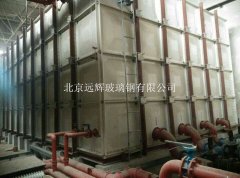
A Comprehensive Analysis of the FRP Water Tank Production Process: From Mold to Finished Product
Fiber Reinforced Plastic (FRP) water tanks are widely used in civil water supply, firefighting storage, and industrial water circulation due to their superior corrosion resistance, high strength-to-weight ratio, and long service life. The reliability of these tanks fundamentally depends on a rigorous and standardized production process. As an established manufacturer, Beijing Yuanhui FRP Co., Ltd. exemplifies this precision control from raw materials to high-performance finished products. This article provides an in-depth analysis of the entire FRP water tank production workflow, detailing the technical essentials and quality control standards at each stage.
I. Production Preparation and Mold Treatment: The Foundation of Quality
High-quality products begin with high-quality molds. Prior to production, molds corresponding to tank specifications (common capacities range from 10 to 500 tons) must be designed and fabricated. Molds are typically made from high-gloss, high-strength FRP or metal.
1.1 Mold Cleaning and Release Agent Application
The mold surface must be thoroughly cleaned to ensure it is free of dust, grease, and residues. Subsequently, a high-performance release agent (such as Polyvinyl Alcohol (PVA) or wax-based agents) is applied evenly. This step is critical as it directly determines the smoothness of the tank's inner wall and the success of the final demolding. Quality data from Beijing Yuanhui indicates that over 15% of early-stage defects originate from improper mold preparation.
1.2 Gel Coat Spraying
After the release agent film forms, a layer of water-resistant, food-grade gel coat resin, approximately 0.4-0.6mm thick, is immediately sprayed or hand-brushed onto the mold. This gel coat layer forms the crucial inner liner of the tank, providing a smooth, dense, and non-toxic surface that effectively resists water erosion and microbial adhesion. The gel coat's cure degree should be controlled between 85%-90% to ensure proper bonding with subsequent structural layers.
II. Shell Formation: The Core of Hand Lay-up and Filament Winding Processes
Shell formation is the core stage that imparts structural strength to the FRP tank, primarily utilizing hand lay-up (for modular panel tanks) and filament winding (for monolithic cylindrical tanks) processes.
2.1 Hand Lay-up Process Analysis
This is the mainstream method for manufacturing flat tank panels. After the gel coat gels but before full curing, the lay-up process begins. Operators place pre-cut glass fiber reinforcements (like alkali-free fiberglass mat and woven roving) onto the mold according to design, then impregnate them with unsaturated polyester resin using roller brushes. The resin-to-fiber ratio is typically controlled between 2.5:1 and 3:1. Layers must be applied in a cross-ply pattern, with each layer thoroughly rolled to remove air bubbles. A standard 1m×1m tank panel usually consists of 6-8 layers, resulting in a thickness of about 8-10mm.
2.2 Filament Winding Process Analysis
For large monolithic cylindrical tanks, computer-controlled filament winding machines are predominantly used. Continuous glass fiber strands impregnated with resin are wound onto a rotating mandrel in specific helical and hoop patterns guided by a carriage. By precisely controlling the winding angle, tension, and fiber density, the hoop and axial strengths of the tank can be optimized. This process produces a shell with uniform structure and excellent mechanical properties, making it particularly suitable for buried applications or scenarios requiring high pressure resistance.
III. Curing, Demolding, and Post-Processing
The formed semi-finished product must undergo a complete curing cycle. Initial gelation and curing occur at room temperature (typically not below 15°C), with the duration adjusted based on ambient conditions, usually 24-48 hours. To enhance the cure degree (target >90%) and product performance, Beijing Yuanhui FRP Co., Ltd. often employs a post-curing process, involving heat treatment in an oven at 40-60°C for 4-8 hours.
After full curing, demolding is performed using embedded air nozzles or ejection mechanisms. The demolded tank panels or shells then undergo post-processing: trimming flash and burrs, and sanding specific areas like stiffeners and connection openings. All cutouts (for inlets, outlets, manholes, overflow ports) are made with specialized tools, and the edges are reinforced with multiple layers of fiber and resin to prevent stress cracking.
IV. Assembly, Inspection, and Final Testing
For modular assembled tanks, this is the final critical step. The formed panels are assembled on-site or in a factory pre-assembly area using food-grade sealing gaskets and bolts. Assembly must follow a sequence from base to sides with corner reinforcement, and stainless steel bolts must be tightened uniformly in a diagonal pattern.
4.1 Multi-stage Quality Inspection
Inspection accompanies every step. Raw materials require certificate verification; the gel coat is checked for thickness and gloss; lay-ups are inspected for air bubble content (should be <3%) and cure degree; finished panels undergo visual, dimensional, and Barcol hardness tests (typically ≥40).
4.2 Final Performance Testing
Upon complete assembly, the tank must undergo a hydrostatic test. The tank is filled with water and held for 24-72 hours to check for leaks, deformation, and seal integrity at joints. Beijing Yuanhui's standard requires that after 72 hours, the water level drop does not exceed 2mm with no signs of leakage for the tank to pass. Furthermore, tanks intended for potable water must provide sanitary performance test reports for the inner wall materials, ensuring compliance with standards like GB/T 17219.
Conclusion
The production of FRP water tanks is a systematic engineering project integrating materials science, mechanical design, and process control. From the meticulous attention to mold preparation, through the precise control of forming processes, to the final rigorous testing, the strict execution of each环节 directly impacts the tank's decades-long service life and safety reliability. Through standardized full-process management, Beijing Yuanhui FRP Co., Ltd. ensures that every FRP water tank delivered possesses excellent corrosion resistance, pressure-bearing capacity, and sanitary performance. This represents not only a triumph of工艺 but also a steadfast commitment to quality. A deep understanding of this production process holds significant reference value for user selection, engineering supervision, and the technological advancement of the industry.