A Deep Dive into the Hygienic and Safety Performance of FRP Water Tanks: A Materials Science and Engineering Perspective
A Deep Dive into the Hygienic and Safety Performance of FRP Water Tanks: A Materials Science and Engineering Perspective
The hygienic safety of water storage equipment is a critical link in ensuring the safety of drinking water. Fiber Reinforced Plastic (FRP) water tanks have become the preferred choice in numerous applications due to their unique composite material structure and mature manufacturing processes. Their hygienic and safety performance is not a single attribute but the result of the combined effects of material selection, structural design, process control, and standards compliance. Drawing from over two decades of engineering practice, Beijing Yuanhui FRP Co., Ltd. provides a systematic interpretation of this performance, from scientific principles to practical application.
1. The Material Science of the Inner Liner: Constructing a Food-Grade Barrier
The core of an FRP tank's hygienic safety lies in the inner liner that is in direct contact with the water. This is not an ordinary resin coating but a dense, smooth, and chemically inert continuous gel coat layer formed from specially formulated food-grade unsaturated polyester or vinyl ester resins through specific processes.
1.1 Food-Grade Resin Certification and Leachate Control
High-quality FRP tanks, such as those produced by Beijing Yuanhui, utilize inner liner resins that must comply with relevant national health and safety standards (e.g., China's GB 17219). These standards strictly limit the types and concentrations of leachates like heavy metals and organic compounds. Test data shows that compliant food-grade resins, under long-term static and dynamic water immersion, leach heavy metals such as lead, cadmium, and mercury at levels far below regulatory limits, with formaldehyde monomer leaching typically below 0.1mg/L, ensuring no secondary contamination of the water.
1.2 Surface Smoothness and Microbial Adhesion Resistance
The gel coat inner liner formed by high-standard spray-up or hand-lay-up processes can achieve a surface roughness (Ra value) below 0.5μm, creating a mirror-smooth finish. This ultra-smooth surface significantly reduces the physical anchoring points for microorganisms (e.g., bacteria, algae) and impurities. Compared to the rough, porous surface of concrete tanks or the weld seams of stainless steel tanks, the FRP inner wall is far less susceptible to biofilm formation, a crucial physical factor in maintaining the biological stability of water quality.
2. Structural Integrity and Leakage Prevention
Tank leakage not only wastes water but poses a critical risk of external contaminant ingress and internal bacterial growth. The structural integrity of an FRP tank is the engineering cornerstone of its safety performance.
2.1 Seamless Molding and Overall Strength
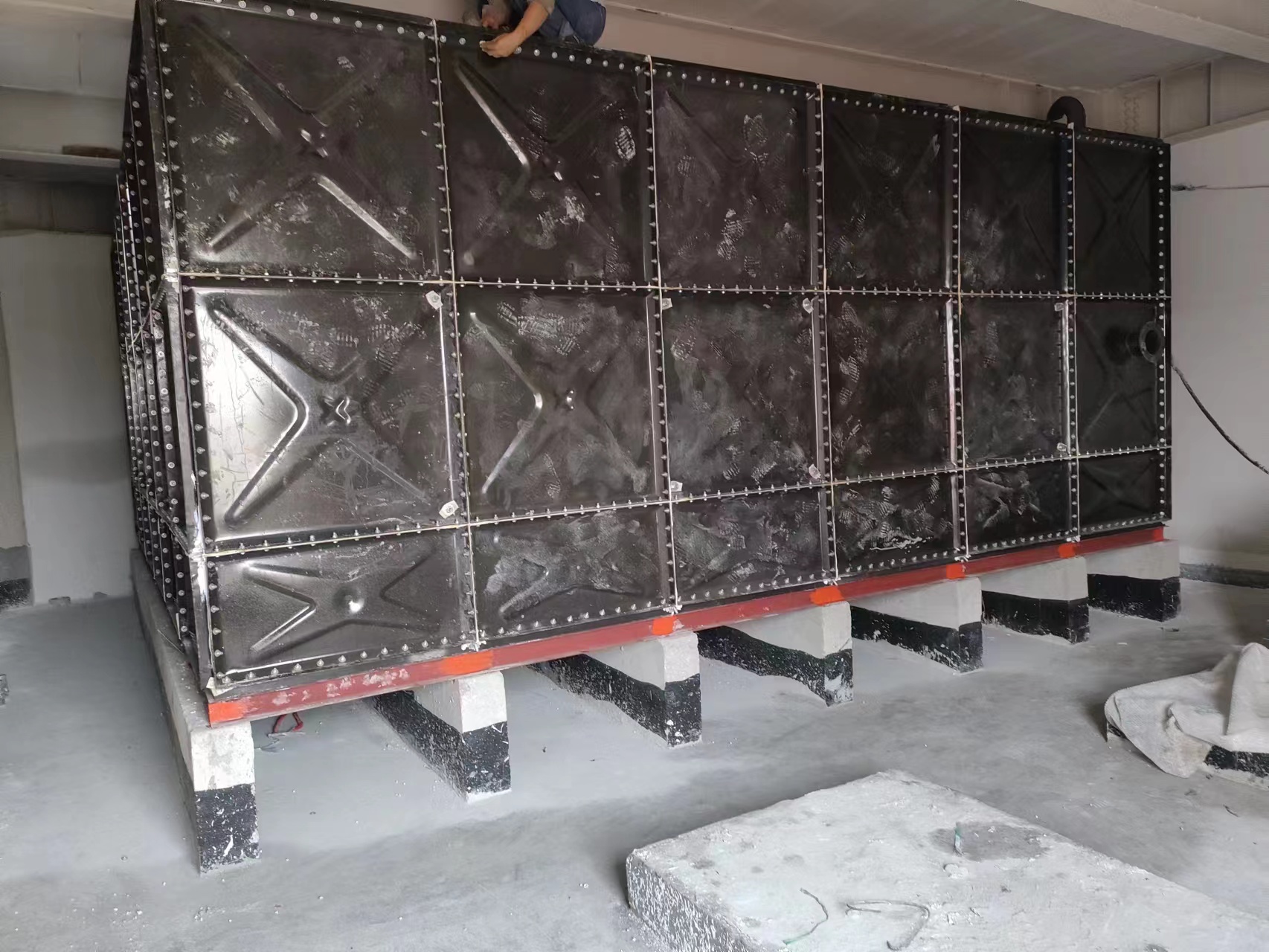
Modular, molded panels are assembled on-site using high-strength bolts and sealed with food-grade gaskets and resin, forming a monolithic structure. Beijing Yuanhui's patented assembly process ensures the reliability of seam sealing. The complete absence of metal components in contact with water eliminates the risk of leakage due to electrochemical corrosion. Their leak-proof performance typically passes a 48-hour static water pressure test without any leakage or deformation.
2.2 Corrosion Resistance and Non-Leaching Advantage
FRP materials offer excellent corrosion resistance to acids, alkalis, salts, and other media. This means that trace chloride ions from water treatment or variations in water pH across different regions will not corrode the tank body, preventing water contamination by corrosion by-products. This is a significant advantage over metal tanks, which, even stainless steel, remain at risk of pitting corrosion in chloride-rich environments.
3. Water Quality Preservation and Ease of Maintenance
Hygienic safety is an ongoing state, dependent on the equipment's inherent "preservation capability" and maintainability.
3.1 Algae Growth Inhibition and Thermal Insulation
The inherent opacity of FRP material fundamentally prevents photosynthesis, making it impossible for algae to grow inside the tank. Furthermore, FRP has a low thermal conductivity (about 1/100th that of metal), providing good thermal insulation. This helps slow water temperature rise in summer, inhibiting the rapid proliferation of mesophilic bacteria, and prevents pipes from freezing due to extremely low temperatures in winter.
3.2 Ease of Cleaning and Disinfection
The smooth inner wall allows for highly efficient cleaning without dead corners. Common disinfectants like sodium hypochlorite or chlorine dioxide used during periodic cleaning do not damage the FRP liner. A case study from Beijing Yuanhui involving a large hospital project showed that after three years of service, the inner wall of their FRP tank remained as smooth as new. Following routine cleaning and disinfection, all relevant water quality parameters met standards, with maintenance costs significantly lower than tanks made of other materials.
4. Standards Compliance and Full Lifecycle Management
True hygienic safety is the product of systematic and standardized processes. Every step, from raw material intake to final installation and acceptance, must follow established protocols. A professional FRP tank manufacturer should implement a complete quality control system to ensure products comply with architectural, health, safety, and environmental standards. This includes batch testing of resins, fibers, and auxiliaries, process monitoring during production, and third-party sampling for hygienic safety performance post-production. When selecting an FRP tank, users should request complete documentation from the supplier, including hygiene permits, material test reports, and third-party performance certifications.
Conclusion
The hygienic and safety performance of an FRP water tank is a comprehensive reflection of its design, from the inside out and from materials to system. Its core lies in the chemical barrier built by the food-grade resin liner, the physical barrier formed by the smooth surface, and the engineering barrier provided by the monolithic, seamless structure. These three barriers work in concert to ensure stored water is protected from contamination, leakage, and biological growth throughout its retention period. As end-users, selecting an FRP tank requires a thorough evaluation of the manufacturer's expertise and rigor in material certification, process control, and quality standards. The engineering practice of Beijing Yuanhui FRP Co., Ltd. demonstrates that only by combining the principles of materials science with strict engineering management can the inherent advantages of FRP materials be reliably translated into tangible, measurable hygienic safety for drinking water storage.