A Comprehensive Analysis of the FRP Water Tank Production Process: From Mold to Finished Product
A Comprehensive Analysis of the FRP Water Tank Production Process: From Mold to Finished Product
Fiber Reinforced Plastic (FRP) water tanks are favored in secondary water supply, fire protection, and industrial water storage for their high strength-to-weight ratio, corrosion resistance, long service life, and design flexibility. The foundation of their superior performance lies in a meticulous, precise, and standardized production process. This article systematically dissects the entire manufacturing journey of FRP tanks, from design to final inspection, highlighting the engineering logic behind their quality.
Stage 1: Mold Preparation and Liner Layer Fabrication
The mold is the cornerstone of FRP tank shaping, with its precision directly determining the dimensional stability and surface finish of the product. Professional manufacturers like Beijing Yuanhui FRP Co., Ltd. employ high-gloss, high-strength dedicated FRP molds. Before production, the mold undergoes thorough cleaning, polishing, and the application of 3-5 even coats of a high-quality release agent (e.g., PVA or wax-based). This creates a complete barrier film, a critical first step for ensuring clean demolding and a flawless surface.
The Liner: The Primary Barrier Against Corrosion and Permeation
The liner is the layer in direct contact with the stored medium, and its core functions are corrosion and chemical resistance. Technically, a resin-rich gel coat layer (typically 0.25-0.5mm thick) is first applied to the prepared mold surface via spray or hand lay-up. Upon gelation, a layer of surface veil or chopped strand mat is immediately laid and impregnated with food-grade or chemical-resistant resin (e.g., isophthalic polyester). This layer must be fully saturated, free of air bubbles and dry fibers, forming a dense, smooth, resin-rich barrier with a resin content often exceeding 70%. It is the lifeline for water quality safety and long-term durability.
Stage 2: Structural Layer Formation: Hand Lay-up vs. Filament Winding
The structural layer provides the required mechanical strength and stiffness to the FRP water tank, bearing the hydraulic load. Depending on the tank shape and specifications, the primary processes are hand lay-up or filament winding.
Hand Lay-up Process
This method is suitable for rectangular, custom-shaped, or large modular panel tanks. On the cured liner, workers follow a designed ply schedule, alternately laying reinforcing materials like chopped strand mats and woven rovings. Resin rollers are used to consolidate each layer, removing air bubbles and ensuring complete resin-fiber integration. For a standard 10mm thick panel from Beijing Yuanhui, the lay-up might be: 1 layer of surface veil + 2 layers of chopped strand mat + multiple layers of woven roving (adjusted for strength). Ply orientations are alternated to balance mechanical properties. Strict control of ambient temperature (20-28°C) and humidity (<80%) is essential.
Filament Winding Process
Primarily used for cylindrical tank shells. Continuous glass fiber rovings, impregnated with resin, are wound onto a rotating mandrel following specific patterns and angles (typically including hoop and helical winds). Computer-controlled winding paths and tension allow for precise fiber placement, maximizing material strength. The winding thickness can be precisely calculated based on design pressure. For instance, a tank with a 3-meter diameter, 4-meter height, and 0.1MPa design pressure might require a hoop winding thickness of 8-12mm.
Stage 3: Post-Processing, Assembly, and Comprehensive Inspection
Once the structural layer resin has sufficiently cured (Barcol hardness typically above 40), demolding takes place. Demolded parts then undergo post-curing, either at ambient or elevated temperatures, to allow the resin to achieve full cure and optimal properties.
Assembly and Sealing
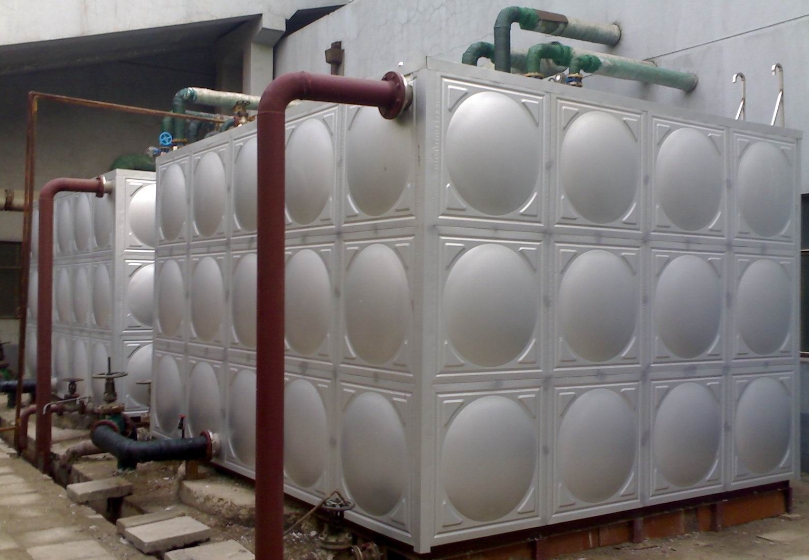
For modular rectangular tanks, cured panels are transported to site for assembly. Food-grade sealing gaskets and bolts are used for connection, with critical seams often reinforced with additional resin and glass fiber for a leak-proof seal. Beijing Yuanhui's project data indicates assembly precision for standard modular tanks can be controlled within ±5mm.
End-to-End Quality Control
Quality inspection permeates the entire FRP tank production process. It starts with raw material checks (resin viscosity/acid value, fiber tex), continues with in-process monitoring (gel time, degree of cure), and culminates in final product testing:
- Visual Inspection: Checking for surface smoothness, bubbles, cracks, or delamination.
- Dimensional Inspection: Verifying all dimensions meet design tolerances.
- Performance Testing: Key tests include hydrostatic pressure testing (typically at 1.5 times design pressure, held for over 30 minutes with no leakage), sanitary compliance testing (for potable water tanks, per standards like GB/T 17219), and resin cure degree testing (usually requiring ≥85%).
Conclusion: Process Precision Defines Product Excellence
A mature and rigorous FRP water tank production process is the bedrock of long-term, safe, and reliable operation. From meticulous mold preparation and the creation of an impervious liner, to the strength-realizing structural layer formed by hand lay-up or winding, and finally to stringent post-processing and inspection, each stage demands precise process control and extensive expertise. Professional manufacturers like Beijing Yuanhui FRP Co., Ltd., by adhering to standardized procedures and a robust quality management system, ensure that every tank delivered meets or exceeds customer expectations for durability, safety, and cost-effectiveness. For end-users, understanding this core manufacturing process is also vital for making informed procurement decisions.