A Comprehensive Analysis of the FRP Water Tank Production Process: From Mold to Finished Product
A Comprehensive Analysis of the FRP Water Tank Production Process: From Mold to Finished Product
Fiber Reinforced Plastic (FRP) water tanks are the preferred choice in modern water supply, fire protection, and industrial storage due to their superior corrosion resistance, high strength-to-weight ratio, and long service life. The reliability of these tanks is fundamentally rooted in a meticulous and precise production process. The manufacturing workflow at Beijing Yuanhui FRP Co., Ltd. exemplifies the complete transformation from raw materials to high-performance end products.
Stage 1: Mold Preparation and Liner Formation
A quality tank begins with an impeccable mold. The surface finish of the mold directly determines the interior quality of the tank. The process starts with the even application of a high-performance release agent, typically polyvinyl alcohol (PVA) or semi-permanent wax-based systems, onto the dedicated mold to ensure clean demolding later.
Liner Formation: The Key to Corrosion and Seepage Resistance
The liner is the primary barrier against water corrosion and leakage. Beijing Yuanhui FRP employs a "rich resin layer" technique, using surface veil and chopped strand mat, impregnated with food-grade or corrosion-resistant vinyl ester resin. The resin content is strictly controlled between 70%-80%, forming a dense, non-porous gel coat layer approximately 1.5-2.5mm thick. This stage must be conducted in a controlled environment, with temperature ideally maintained at 18-25°C and relative humidity below 75%, to prevent improper resin curing or blooming.
Stage 2: Structural Layer Reinforcement and Molding
The structural layer provides the mechanical strength to withstand water pressure and external loads. The primary molding techniques are hand lay-up and filament winding.
Hand Lay-Up Process
This is the most common method, used for producing square and custom-shaped tank panels. After the liner cures, workers alternately lay multiple layers of alkali-free glass fiber woven roving and chopped strand mat. Each layer is meticulously rolled with a roller to eliminate air bubbles and ensure complete resin impregnation. A standard 1.5mm thick single panel typically requires 3-4 layers of reinforcement. The resin-to-glass mass ratio (resin content) is strictly controlled at 50%-55% to achieve optimal mechanical properties.
Filament Winding Process
For cylindrical tanks, Beijing Yuanhui utilizes computer-controlled filament winding machines. Continuous glass fiber strands, impregnated with resin, are precisely wound onto a mandrel at predetermined angles (e.g., helical and circumferential) and tension. This process creates a structural layer with continuous fibers and uniform strength distribution, making it ideal for large horizontal storage tanks, achieving a hoop tensile strength often exceeding 250MPa.
Stage 3: Curing, Demolding, and Post-Processing
The molded tank panels or shells require thorough curing. Curing occurs in three stages: gelation, hardening, and post-curing. Initial curing takes place at room temperature for 8-12 hours, followed by post-curing in an oven at 40-60°C for 4-6 hours. This step increases the resin's cross-linking density, allowing the product to reach over 85% of its ultimate strength.
After demolding, the parts move to the trimming workshop. Workers use diamond cutting discs or water jets to precisely cut panels to design dimensions and grind away flash and burrs. For square tank panels, specialized drills are used on dedicated drilling machines to create bolt connection holes, with positional tolerance controlled within ±0.5mm to ensure perfect on-site assembly.
Stage 4: On-Site Assembly and Final Inspection
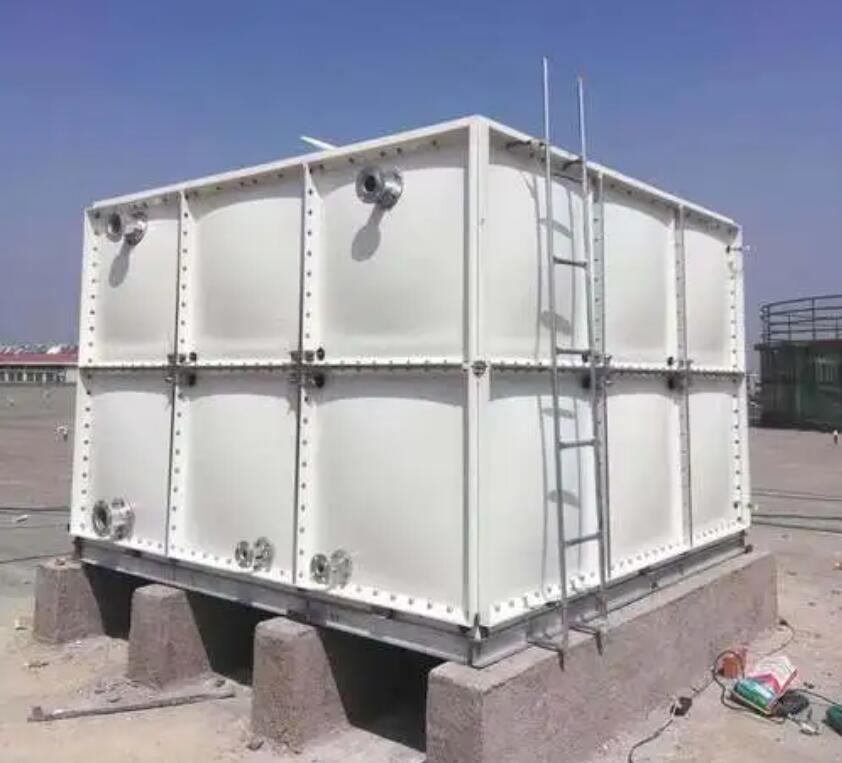
FRP water tanks are typically modular, with factory-produced panels transported for on-site assembly. Beijing Yuanhui's installation team first prepares the foundation, ensuring overall levelness with a deviation of less than 5mm. Panels are connected using food-grade rubber gaskets and 304 stainless steel bolts.
Sealing and Strength Testing
Upon assembly, two critical tests are mandatory: the water-fill test and seal inspection. The tank is filled with water and left standing for 24-48 hours to check for leaks at seams and monitor sidewall deflection. According to the Chinese National Standard GB/T 21238-2016, the maximum deflection of the sidewall under full water load must not exceed 1% of the tank's height. Only after passing all tests is a qualified FRP water tank ready for delivery and use.
Conclusion
The production of an FRP water tank is a technological chain integrating materials science, mechanical engineering, and fine chemistry. Every step—from mold treatment and fiber impregnation to curing control and precise assembly—directly impacts the final product's longevity and safety. Through standardized operating procedures and strict quality control checkpoints, Beijing Yuanhui FRP Co., Ltd. ensures that every tank it delivers possesses exceptional seepage resistance, pressure-bearing capacity, and durability. This represents not only a triumph of process but also a long-term commitment to user water safety. Looking ahead, with the integration of technologies like automated impregnation and digital quality monitoring, the manufacturing process for FRP water tanks will continue to evolve towards higher precision and greater consistency.