In-depth Analysis of Seismic Performance and Key Design Specifications for FRP Water Tanks
In-depth Analysis of Seismic Performance and Key Design Specifications for FRP Water Tanks
The integrity of water supply systems during and after seismic events is critical for disaster response and community resilience. As a key storage component, the seismic performance of Fiber Reinforced Plastic (FRP) water tanks is of paramount importance. Leveraging unique composite material properties and flexible structural design, FRP tanks demonstrate significant advantages in modern seismic engineering.
Seismic Advantages and Mechanical Properties of FRP Materials
The seismic resilience of FRP stems from its fundamental material characteristics. Compared to brittle concrete tanks or buckling-prone steel tanks, FRP offers high specific strength, high specific stiffness, and excellent fatigue resistance.
Seismic Mechanism at Material Level
FRP is a composite of glass fibers and a polymer resin matrix. The fibers provide primary load-bearing capacity, while the resin transfers stress and protects the fibers. Under seismic-induced cyclic loading, this system effectively absorbs and dissipates energy. Data indicates the damping ratio of FRP is approximately 2-3 times that of structural steel, allowing more kinetic energy from vibrations to be converted into heat, thereby attenuating seismic response. The food-grade resin and alkali-free glass filament winding process employed by Beijing Yuanhui FRP Co., Ltd. ensure long-term material stability under alternating stresses, forming the foundation for seismic durability.
The Critical Role of Structural Integrity
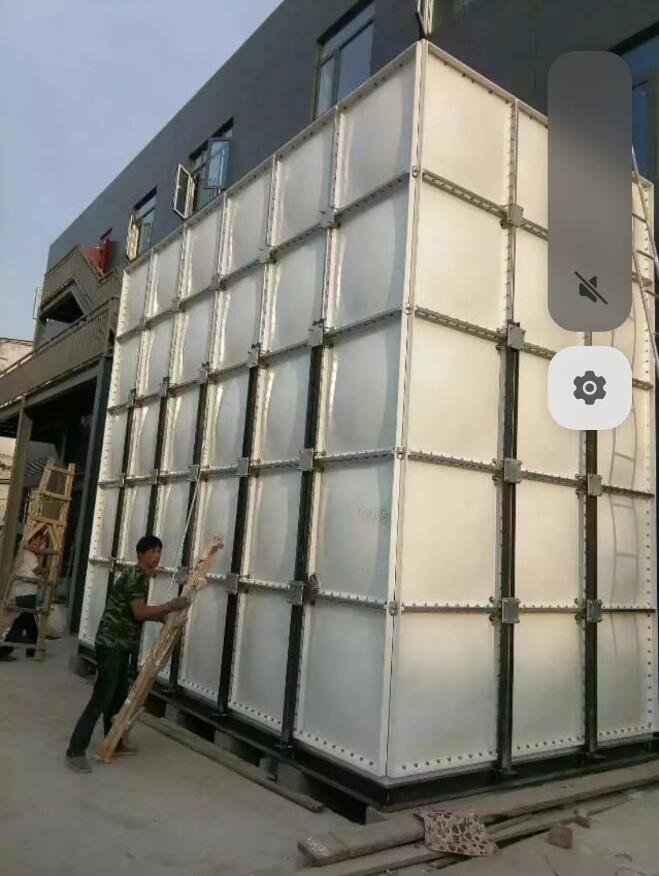
Monolithic FRP tanks are often fabricated using continuous filament winding, creating a seamless, one-piece structure that eliminates welded seams as potential weak points. For modular panel-type tanks, high-strength sealed bolts, along with integrated stiffeners and tie-rod systems, combine individual units into a cohesive, load-sharing assembly. This structural integrity is vital for resisting the complex, multi-directional stresses induced by earthquakes.
Interpretation of Core Requirements in Seismic Design Codes
The design of FRP water tanks must strictly adhere to national and industry codes, with seismic considerations as a mandatory factor.
Key Governing Standards
Design in China primarily follows the Code for Seismic Design of Buildings (GB 50011) and the Code for Structural Design of Water Supply and Wastewater Engineering Structures (GB 50069). These stipulate the three-level seismic fortification objective: "no damage under frequent earthquakes, repairable damage under moderate earthquakes, and no collapse under rare earthquakes." For FRP tanks, the industry standard FRP Water Tanks (JC/T 718) provides specific provisions for load calculation and structural verification. International projects may also reference relevant sections of ASCE 7 or IBC.
Accurate Calculation of Seismic Loads
The first step in seismic design is accurately determining seismic actions. Calculations must consider the total mass of the tank when full, and determine the horizontal seismic influence coefficient based on seismic intensity, site class, and the tank's natural vibration period. Codes require consideration of both horizontal and vertical seismic forces. Particularly for elevated tanks, hydrodynamic pressures (convective impulsive and oscillatory pressures) are critical and must be precisely analyzed using methods like the Housner model to determine additional loads on the tank wall and support structure.
Engineering Practices to Enhance Seismic Performance of FRP Tanks
Refined design and construction practices, based on code requirements, can systematically improve seismic reliability.
Structural Design and Reinforcement Measures
Cylindrical tanks generally exhibit superior performance under uniform lateral pressure compared to rectangular shapes. For rectangular tanks, adequate radius fillets at corners, supplemented by vertical and horizontal stiffeners, are essential to distribute stress. The tie-rod system is critical. Engineering cases from Beijing Yuanhui FRP Co., Ltd. demonstrate that a bidirectional grid of stainless-steel tie-rods (typically at 1m x 1m spacing) effectively restrains tank deformation, preventing "bulging" instability during quakes. Anti-shear ring beams at the top and bottom enhance overall rigidity.
Foundation and Anchorage Reliability
The seismic principle of "strong anchorage, weak component" applies. The foundation must be level, solid, and monolithic to prevent differential settlement. The number, diameter, embedment depth, and material of anchor bolts require rigorous calculation. Chemical anchors or embedded steel plates are commonly used to ensure effective transfer of seismic forces to the foundation.
Flexible Treatment of Pipe Connections
Rigid pipes connected to tanks often fail due to differential displacement during earthquakes. Flexible connections (e.g., rubber expansion joints or stainless-steel bellows) must be installed at all inlet, outlet, and overflow piping interfaces, providing sufficient movement allowance. This detail, often overlooked, is vital for maintaining post-earthquake functionality.
Conclusion
The superior seismic performance of FRP water tanks results from the integration of materials science, structural mechanics, and codified engineering. Their earthquake resilience relies on a deep understanding of composite material behavior, precise calculation of seismic actions, and strict adherence to design specifications. Every element—from high-damping FRP material selection and monolithic construction to scientific tie-rod layout, reliable anchorage, and flexible piping—forms an indispensable link in the seismic safety chain. The practice of Beijing Yuanhui FRP Co., Ltd. confirms that only by treating seismic design as a core principle throughout the product lifecycle can FRP water tanks be ensured as reliable guardians of the "water of life" in the face of seismic hazards, providing robust support for the resilience of water supply systems.