In-Depth Analysis of Seismic Performance in FRP Water Tanks: Design Codes and Engineering Practice
In-Depth Analysis of Seismic Performance in FRP Water Tanks: Design Codes and Engineering Practice
Earthquake disasters pose a severe challenge to the safety of water supply systems. As a critical water storage facility, the seismic performance of Fiber Reinforced Plastic (FRP) water tanks directly impacts post-earthquake emergency water supply and the recovery of lifeline engineering. FRP material, with its characteristics of light weight, high strength, corrosion resistance, and design flexibility, demonstrates unique advantages in the field of seismic-resistant storage equipment. A deep understanding of its anti-seismic mechanisms and strict adherence to design codes are fundamental to ensuring the safety and functional integrity of tanks under seismic action.
Seismic Advantages and Mechanisms of FRP Water Tanks
The seismic performance of FRP tanks is rooted in their material and structural properties. Compared to traditional concrete or steel tanks, their core advantage lies in mass. The density of FRP material is approximately 1.8-2.0 g/cm³, significantly lower than that of steel and concrete. This results in substantially reduced inertial forces (seismic force is proportional to mass) during an earthquake, lowering the requirements for foundations and support structures.
Material Properties and Structural Response
FRP material boasts a high strength-to-weight and stiffness-to-weight ratio, coupled with good elasticity and toughness. When subjected to alternating loads induced by seismic activity, the FRP shell can absorb and dissipate seismic energy through elastic deformation rather than brittle failure. The filament winding or molding process ensures the integrity of the tank body, avoiding potential stress concentration issues at welds common in steel plate tanks, thereby enhancing fatigue and deformation resistance.
The Critical Role of Connection and Support Systems
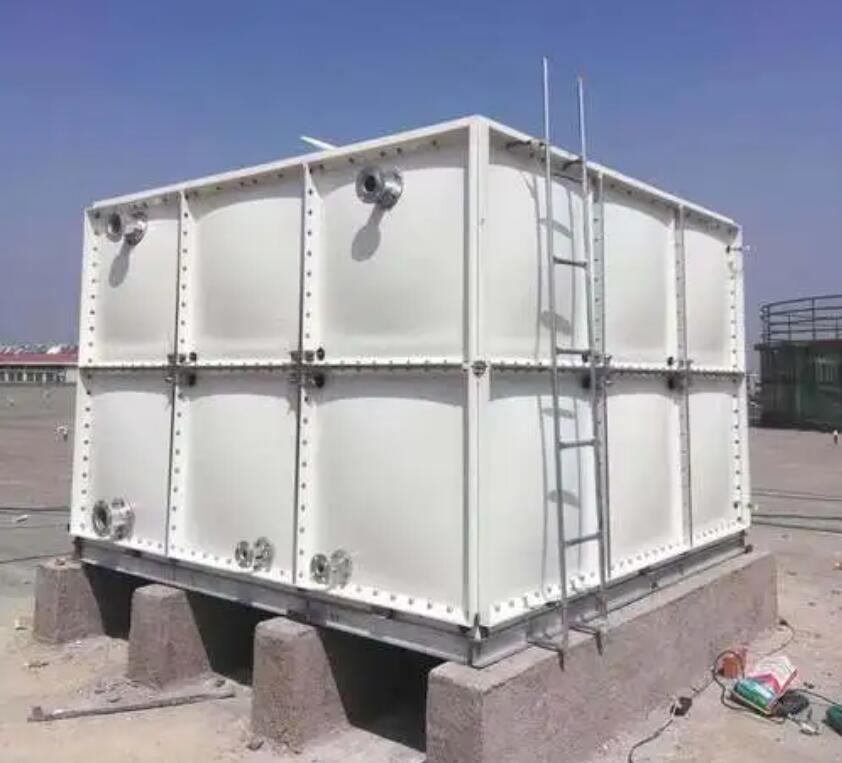
Seismic performance depends not only on the tank itself but also on a scientifically designed support and connection system. Modular FRP tanks utilize food-grade resin sealing strips and bolt connections, creating flexible joints that allow for minor relative displacement between panels, effectively releasing seismic stress. In the engineering practice of Beijing Yuanhui FRP Co., Ltd., particular attention is paid to foundation design and anchorage. This typically involves a concrete foundation platform that fully conforms to the tank bottom, equipped with chemical anchors or embedded steel plates that meet seismic calculation requirements to prevent sliding or overturning during an earthquake.
Analysis of Seismic Design Codes and Standards
The seismic design of FRP water tanks must strictly follow relevant national and industry codes. In China, the primary references are the "Code for Seismic Design of Buildings" (GB 50011) and the "Code for Structural Design of Water Supply and Wastewater Engineering Structures" (GB 50069). While these codes do not have separate provisions specifically for FRP tanks, their regulations regarding seismic action calculation, load combinations, and seismic measures for liquid-containing structures are mandatory guidelines.
Load Calculation and Load Case Combinations
In design, the tank must be treated as a liquid-containing structure, calculating the hydrodynamic pressure under seismic action. The pseudo-static method is commonly used, considering the horizontal seismic influence coefficient to compute the inertial forces from the tank's self-weight and water content, as well as the additional hydrodynamic pressure on the tank walls and bottom. Seismic load cases must be combined with normal use, hydrostatic test, and other cases, with the most unfavorable combination used for strength, stiffness, and stability checks. For instance, in projects located in regions with a seismic fortification intensity of 8 degrees (0.20g), seismic action often becomes one of the controlling design loads.
Detailing Requirements and Constructional Measures
The codes emphasize the fortification objective of "no damage under minor earthquakes, repairable under moderate earthquakes, and no collapse under major earthquakes." Specific to FRP tanks, constructional measures include: reinforcing the circumferential and longitudinal stiffness at the top and bottom of the tank to prevent "elephant's foot" buckling; performing seismic checks on the internal tie-rod system to ensure it can effectively restrain panel deformation during an earthquake; and installing flexible joints at pipe inlets/outlets to prevent pipe rupture due to structural displacement. The design team at Beijing Yuanhui FRP Co., Ltd. strictly adheres to these principles, conducting specialized seismic calculations and design from the initial project phase.
Engineering Practice and Case Study: Beijing Yuanhui's Approach
Theoretical codes must ultimately be validated through engineering practice. In a hospital expansion project located in a key seismic monitoring area in North China, Beijing Yuanhui FRP Co., Ltd. was contracted to supply and install two 500-cubic-meter FRP fire water tanks. The project's seismic fortification intensity was 8 degrees, with a design basic seismic acceleration of 0.20g.
Targeted Design Solutions
Addressing the characteristics of the high-intensity zone, the company's technical team implemented several reinforcement measures. First, the thickness of standard panels was specifically increased in critical areas (e.g., the lower third of the height) to enhance bending and shear resistance. Second, the layout density and diameter of the internal stainless steel tie-rods were optimized to form a denser spatial grid constraint system. Third, foundation anchorage employed a higher-than-standard number of M20 chemical anchors, with on-site pull-out tests conducted.
Simulation Analysis and Installation Control
During the design phase, finite element analysis software was used to simulate the stress and strain of the tank under seismic waves, focusing on the response at corners and water level variation points. During installation, strict control was maintained over panel alignment and bolt tightening torque to ensure uniform force distribution. Since commissioning, the tanks have withstood several perceptible earthquakes, with the structure remaining intact and fully functional, validating the effectiveness of the seismic design.
Key Points for Enhancing the Seismic Performance of FRP Tanks
Synthesizing design and practical experience, ensuring excellent seismic performance in FRP water tanks requires focusing on several core aspects. Design is the source; precise seismic action calculation and load combination based on codes are essential, avoiding estimations based solely on experience. Material and工艺 are the foundation; resins and fibers with high mechanical properties should be selected, and process stability in winding or molding must be guaranteed. Detailing is the safeguard; the tie-rod system, anchorage method, pipe interfaces, and other details determine the lower limit of overall performance. Finally, qualified installation and inspection are the final, crucial step, requiring execution by professional teams according to the design drawings.
Conclusion: The seismic performance of FRP water tanks is a systematic engineering subject, integrating materials science, structural mechanics, and code standards. With the continuous development of seismic theory and the application of new material technologies, the seismic design of FRP tanks will become more refined and intelligent. For users and design institutes, selecting a supplier with profound technical expertise and strict quality control, such as Beijing Yuanhui FRP Co., Ltd., is vital for obtaining a safe and reliable seismic water storage solution. In addressing the challenges of seismic hazards, high-performance FRP water tanks will continue to play an irreplaceable role in safeguarding water supply security.